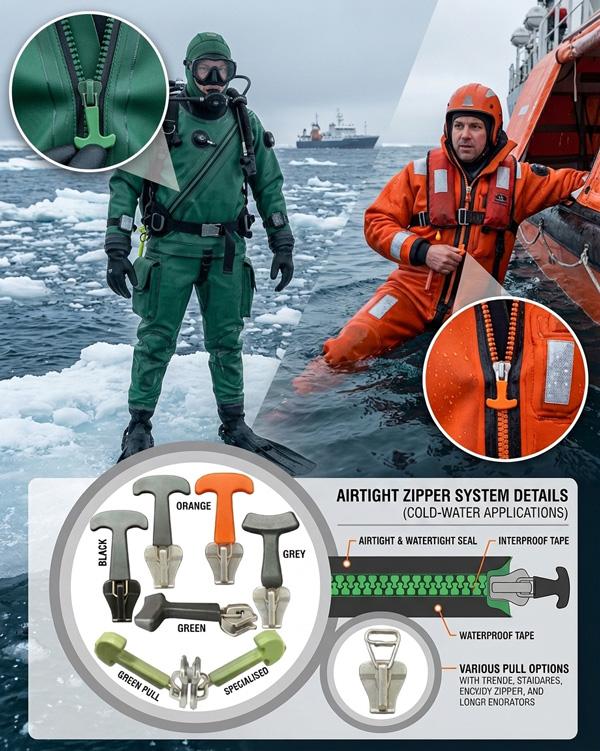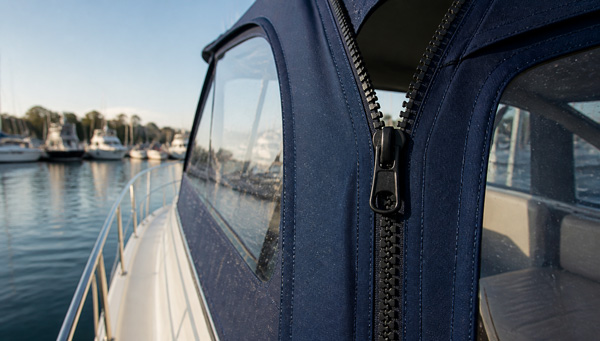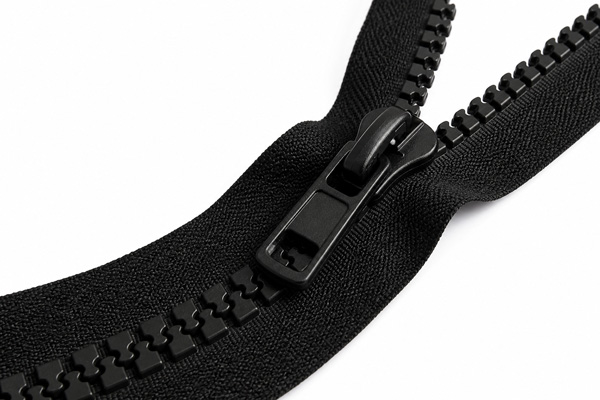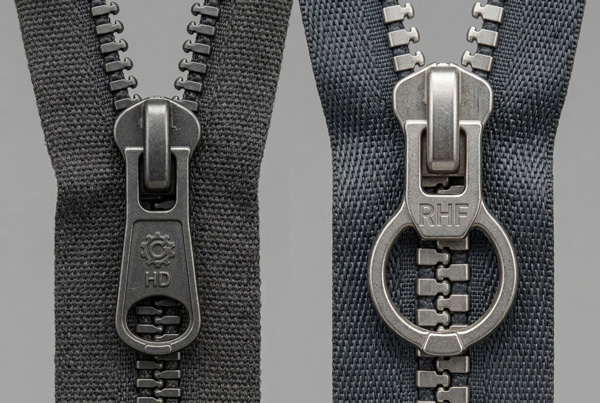
Airtight zippers are mainly used in drysuits and marine survival suits, hazardous-material protective equipment, medical isolation enclosures, inflatable structures, and technical outdoor or marine equipment. Selection should be based on differential pressure, allowable leakage, environmental media, installation method, and cycle life—not simply on a product being described as “completely airtight.”
Although all five applications may use airtight zippers, their procurement requirements differ. Drysuits focus on water ingress and low-temperature operation. Chemical protective suits require evidence of closure integrity and chemical resistance. Inflatable structures depend on pressure retention, while isolation enclosures require defined positive or negative pressure. Technical-equipment buyers must first determine whether a conventional waterproof zipper is already sufficient.
An airtight zipper is a reusable sealing component. Its final performance depends on the sealing profile, coated tape, slider engagement, end termination, installation joint, and surrounding product material. Testing a loose zipper does not automatically establish the sealing performance of the finished product.
If you have not yet determined whether your product requires a waterproof, watertight, or airtight closure, read our guide to the differences between airtight and waterproof zippers.
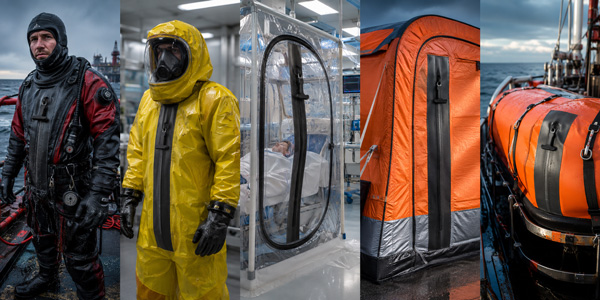
Five Airtight Zipper Applications at a Glance
| Application | First Buyer Decision | RFQ Information | Required Validation |
|---|---|---|---|
| Drysuits and marine survival suits | Whether the suit requires watertight or airtight performance | Suit material, length, position, temperature, saltwater exposure, and cycle life | Water ingress, low-temperature operation, strength, and installed-suit performance |
| Hazmat and chemical protective equipment | Whether protection is required against liquids, gases, or specific chemicals | Chemical, concentration, temperature, exposure time, and garment classification | Suit pressure retention, material permeation, and seam integrity |
| Medical isolation enclosures | Whether the enclosure operates under positive or negative pressure | Pressure, leakage limit, disinfectant, temperature, membrane, and access frequency | Complete-enclosure leakage and performance after cleaning cycles |
| Inflatable shelters and air structures | Whether the zipper is an access opening or part of the pressure boundary | Working pressure, allowable leakage, zipper length, chamber material, and pressure cycles | Pressure decay, leakage rate, end termination, and welded-joint strength |
| Technical outdoor and marine equipment | Whether a waterproof zipper is already sufficient | Immersion, salt, dust, temperature, air-exchange, and opening-cycle requirements | Finished-product ingress, leakage, aging, and durability testing |
1. Airtight Zippers for Drysuits, Immersion Suits, and Marine Survival Suits
Airtight and watertight zippers are commonly used in commercial drysuits, immersion suits, abandonment suits, search-and-rescue suits, and other marine survival clothing. They provide a sufficiently large opening for donning and removal while helping restrict water ingress after the closure is fully engaged.
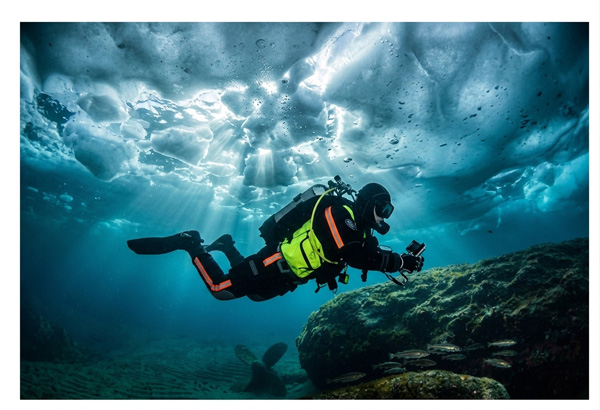
What Should a Drysuit Buyer Decide First?
The first decision is whether the finished suit requires only watertight protection or must also control air leakage. The answer affects the zipper structure, end termination, installation method, operating force, and validation process.
- Freshwater or saltwater exposure
- Maximum immersion conditions
- Minimum and maximum operating temperatures
- Front-entry or rear-entry installation
- Operation while wearing gloves
- Suit fabric, coating, and joining process
- Required opening and closing cycles
Certain professional semi-dry suits may use highly water-resistant or watertight closures. However, true airtight performance is not required in every semi-dry suit design.
What Should Be Included in the RFQ?
- Type of suit and intended use
- Suit fabric and coating
- Required zipper length and configuration
- Installation position and process
- Operating-temperature range
- Saltwater conditions and expected cycle life
- Finished-suit water-ingress requirement
What Evidence Should the Supplier Provide?
- Crosswise chain strength
- Slider-lock and stop-retention strength
- Operating force at the required temperature
- Opening and closing cycle results
- Performance after saltwater conditioning
- A welded or bonded sample made with the intended suit fabric
ISO 15027-1:2026 covers constant-wear immersion suits, ISO 15027-2:2026 covers abandonment suits, and ISO 15027-3:2026 provides test methods. These standards apply to finished suit systems rather than loose zipper components.
Further reading: If you are sourcing a zipper for a drysuit, immersion suit, or marine survival suit, read 9 Questions to Ask Before Buying Airtight Zippers for Drysuits and Marine Survival Suits.
2. Airtight Zippers for Hazmat Suits and Chemical Protective Equipment
Airtight zippers are used in totally encapsulating chemical protective suits, hazardous-material response suits, CBRN equipment, industrial decontamination suits, and vapor-protective garments. Failure of the closure may allow hazardous liquids, gases, aerosols, or vapors to enter the protective ensemble.
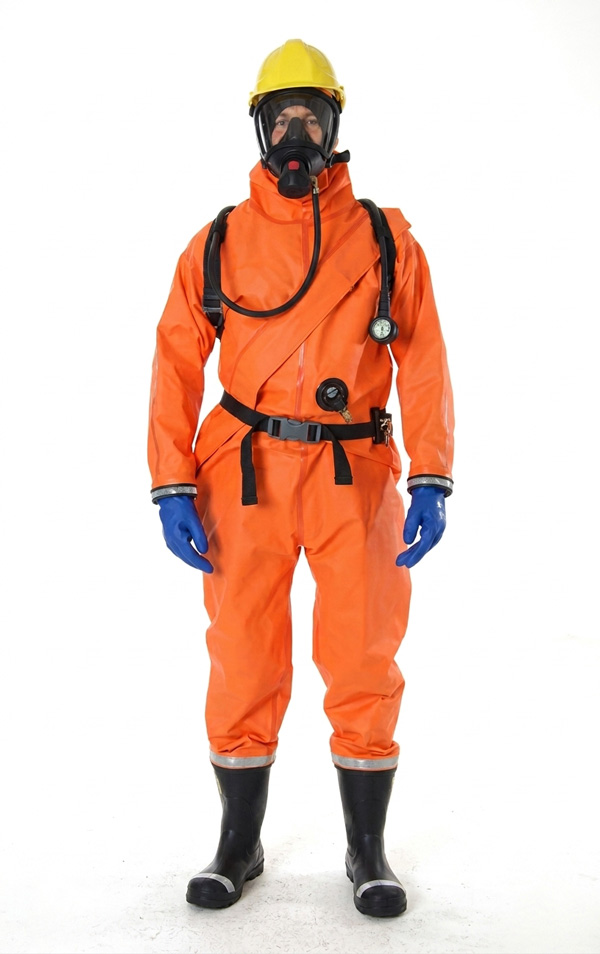
What Should a Chemical-Protective-Suit Buyer Decide First?
The buyer must separate physical leakage, chemical permeation, and leakage through the installation joint. These are different failure mechanisms and require different evidence.
- Leakage through the closed zipper or end termination
- Chemical permeation through tape, coating, or sealing materials
- Leakage through the zipper-to-garment joint
A low air-leakage result does not establish chemical resistance. A coating that resists one chemical also does not prove that the completed suit is gas-tight or suitable for other chemicals.
What Should Be Included in the RFQ?
- Chemical name and concentration
- Liquid, aerosol, gas, or vapor exposure
- Exposure temperature and duration
- Required garment classification
- Garment material and joining process
- Decontamination chemicals and expected reuse cycles
What Evidence Should the Supplier Provide?
- Chemical-compatibility data for the identified substance
- Material breakthrough-time or permeation data
- Zipper and seam specimen reports
- Installed-suit pressure-retention results
- Performance after decontamination
ASTM F1052-20 evaluates the pressure integrity of vapor-protective suits, including seams and closures. ISO 6529:2026 evaluates the permeation resistance of protective-clothing materials against liquid and gaseous chemicals. Neither standard allows a loose zipper to be treated as proof of complete-garment protection.
Further reading: If you are buying airtight zippers for Hazmat suits, CBRN equipment, or chemical protective clothing, read 10 Technical Requirements to Confirm Before Buying Airtight Zippers for Hazmat Suits.
3. Airtight Zippers for Medical Isolation Chambers and Cleanroom Enclosures
Some medical, laboratory, and controlled-environment products require a reusable access opening that limits uncontrolled air or particulate exchange. Applications include portable isolation chambers, negative-pressure enclosures, decontamination chambers, flexible laboratory containment, and controlled-environment access panels.
What Should an Isolation-Enclosure Buyer Decide First?
The first decision is whether the enclosure operates under positive or negative pressure. Positive pressure generally reduces the entry of external contamination, while negative pressure limits the escape of contaminants from inside the enclosure.
Pressure direction must be specified because it can change how the zipper’s sealing surfaces and end termination are loaded.
What Should Be Included in the RFQ?
- Positive or negative pressure
- Normal and maximum temporary pressure
- Maximum allowable leakage and hold time
- Enclosure membrane and joining method
- Cleaning agent, temperature, and cycle count
- Required access frequency and gloved operating force
What Evidence Should the Supplier Provide?
- Leakage data in the specified pressure direction
- A welded sample using the customer’s enclosure membrane
- Disinfectant-compatibility data
- Leakage results after repeated cleaning
- End-termination and installation-joint results
Airtight does not automatically mean sterile, biocompatible, virus-proof, cleanroom-certified, or approved for medical-device use. Autoclave compatibility must also be validated because steam temperatures of approximately 121–134°C may damage certain coatings, adhesives, plastic components, or sealing profiles.
Further reading: If you are selecting a zipper for an isolation chamber, negative-pressure enclosure, or cleanroom containment system, read Buying Airtight Zippers for Medical Isolation Enclosures: Pressure, Leakage, and Disinfection Compatibility.
4. Airtight Zippers for Inflatable Shelters and Flexible Air Structures
Airtight zippers may be used in inflatable emergency shelters, military air-beam tents, flexible air chambers, field-deployable enclosures, rescue systems, and pressure-equipment service openings.
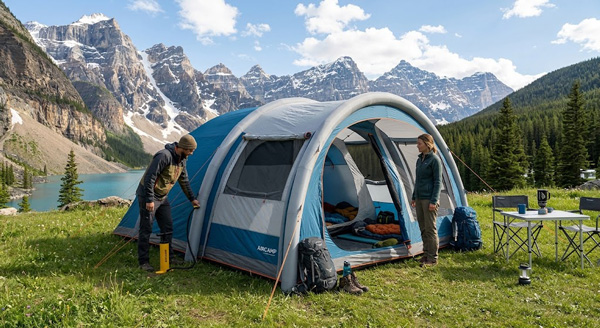
What Should an Inflatable-Product Buyer Decide First?
The buyer must determine whether the zipper is only an access opening or forms part of the pressure boundary. An access zipper may provide access to an internal bladder without directly sealing the primary chamber. A pressure-boundary zipper directly contributes to retaining pressure.
When the zipper is part of the pressure boundary, the chain, end termination, welded area, reinforcement, and surrounding fabric must all be tested.
What Should Be Included in the RFQ?
- Final product and function of the zipper
- Normal and maximum temporary pressure
- Pressure direction and allowable leakage
- Required pressure-hold time
- Zipper length and end configuration
- Chamber material and welding method
- Pressure and opening-cycle requirements
What Evidence Should the Supplier Provide?
- Leakage results at a stated pressure
- Pressure-decay test conditions and chamber volume
- Tested zipper length and end configuration
- Installed-assembly results
- Weld-peel strength and pressure-cycle results
A statement such as “maintains pressure for several days” is incomplete unless it specifies the initial pressure, allowable pressure loss, test duration, temperature, chamber volume, and other possible leakage paths.
Further reading: If you are sourcing an airtight zipper for an inflatable shelter, air-beam structure, or flexible air chamber, read Buying Airtight Zippers for Inflatable Structures: 9 Pressure and Welding Parameters to Confirm.
5. Airtight Zippers for Technical Outdoor and Marine Equipment
Airtight zippers can also be used in industrial dry bags, marine-equipment enclosures, professional spray decks, emergency-response bags, military protective packaging, precision-instrument cases, and medical-equipment transport systems.
This category concerns industrial and professional OEM products rather than personal phone pouches, travel organizers, or ordinary consumer backpacks.
What Should a Technical-Equipment Buyer Decide First?
The most important decision is whether the product genuinely needs an airtight zipper or whether a conventional waterproof zipper is sufficient.
A product exposed only to rain or temporary splashing may not benefit from a heavier and more expensive airtight closure. Airtight performance becomes relevant when the product must control:
- Air exchange or pressure loss
- Extended submersion leakage
- Dust or particulate entry
- Salt atmosphere or humidity
- Industrial vapor or a controlled internal environment
What Should Be Included in the RFQ?
- Equipment or packaging application
- Media that must be excluded
- Immersion depth and duration
- Air-exchange requirement
- Temperature, saltwater, UV, and dust exposure
- Opening cycles, enclosure material, and installation process
What Evidence Should the Supplier Provide?
- Finished-product water-ingress results
- Leakage data at the specified pressure
- Opening and closing cycle results
- Performance after saltwater, UV, or temperature conditioning
- A welded sample using the intended enclosure material
Highly sealed equipment bags also require consideration of condensation and altitude-related pressure changes. Restricting air exchange may trap moisture unless the complete packaging system includes suitable moisture-control measures.
Further reading: If you are buying sealing zippers for industrial dry bags, rescue-equipment bags, military packaging, or marine equipment, read Sealing Zippers for Technical Outdoor and Marine Equipment: Airtight or Waterproof?.
Information Every Airtight Zipper RFQ Should Include
- Final product and intended use
- Media that must be excluded
- Positive or negative pressure
- Working pressure and peak pressure
- Maximum allowable leakage
- Zipper length and configuration
- Product material and joining process
- Operating temperature and environmental exposure
- Required opening cycles
- Applicable regulations or finished-product certifications
How Can Buyers Determine Whether a Test Report Is Valid?
ASTM D2061-07(2021) provides methods for evaluating mechanical properties such as chain strength, element strength, slider-lock strength, and stop retention. It does not establish airtightness.
A useful pressure or leakage report should identify the zipper model, production batch, zipper length, end configuration, pressure, pressure direction, test medium, hold time, temperature, leakage limit, environmental conditioning, cycle count, and whether the specimen was a loose zipper or an installed assembly.
How Should Buyers Evaluate an Airtight Zipper Manufacturer?
RHF Zipper’s public company profile states that the company has manufactured zippers since 2008 and serves customers in more than 60 countries. It also lists OEKO-TEX Standard 100, GRS, and BSCI among its certification or compliance references. Buyers should request current documents and verify the certificate holder, facility, product scope, and validity period.
BSCI is a social-compliance audit framework rather than a product certification for pressure, leakage, or tensile strength. Airtight zipper projects still require model-specific pressure reports, leakage data, mechanical results, material declarations, batch traceability, installation samples, and finished-product testing.
Frequently Asked Questions
How Do I Choose Between an Airtight and Waterproof Zipper?
A waterproof zipper is usually sufficient when the product only needs protection against rain or short-term splashing. An airtight zipper should be evaluated when the product must retain pressure, limit air exchange, withstand extended immersion, or control contaminants.
Does ASTM D2061 Prove That a Zipper Is Airtight?
No. ASTM D2061 evaluates mechanical properties of zipper chains and components, not gas leakage or pressure retention. Airtightness requires a separate leakage or pressure-decay test under defined installation conditions.
Should Buyers Test the Loose Zipper or the Finished Product?
Both tests can provide useful information, but final approval should be based on the installed assembly. Zipper ends, welded seams, bonding areas, and surrounding product materials can all become leakage paths.
What Are the Most Important Airtight Zipper Purchasing Parameters?
The key parameters are differential pressure, maximum allowable leakage, operating temperature, exposure media, zipper length, installation method, and cycle life. Without these conditions, a “100% airtight” claim has no comparable engineering meaning.
Conclusion
The five major applications for airtight zippers follow different purchasing logic. Drysuits require control of water ingress under marine and low-temperature conditions. Chemical protective suits require evidence of closure integrity and chemical resistance. Medical enclosures need a defined pressure direction and validation after cleaning. Inflatable structures require quantified pressure retention, while technical outdoor and marine equipment buyers must first determine whether an airtight zipper is necessary.
For detailed information about zipper structures, materials, sealing principles, and installation methods, read our Complete Guide to Airtight Zippers.
If you are developing a drysuit, chemical protective suit, medical enclosure, inflatable structure, or technical marine product, provide RHF Zipper with the application, pressure or leakage requirement, zipper length, product material, installation process, and operating environment. A sample made with the intended material should be tested as an installed assembly before bulk production is approved.