Choosing Airtight Zippers for Drysuits and Marine Survival Suits: 9 Safety Questions to Ask Before Buying
In extreme water environments, the airtight zipper is often one of the longest and most complex openable seals on a drysuit or marine immersion suit. An incorrectly specified zipper can allow water ingress, reduce thermal protection, interrupt an underwater task, or compromise an emergency abandonment procedure.
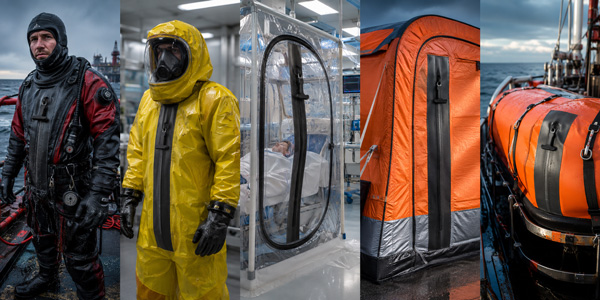
These garments do not have the same operating profile. A drysuit is designed for frequent use under changing underwater conditions. An immersion suit may remain in storage for long periods but must work immediately during an emergency. The zipper therefore has to be selected around the wearer, the environment, the pressure conditions, the garment construction, and the consequences of failure—not simply around size or price.
Direct answer: Before buying an airtight zipper for either garment, confirm its sealing pressure, zipper construction, resistance to the intended marine environment, cold-weather operating force, flexibility, service-life profile, dimensions, installation compatibility, and supporting test evidence. A zipper test result alone does not prove the performance of the finished suit.
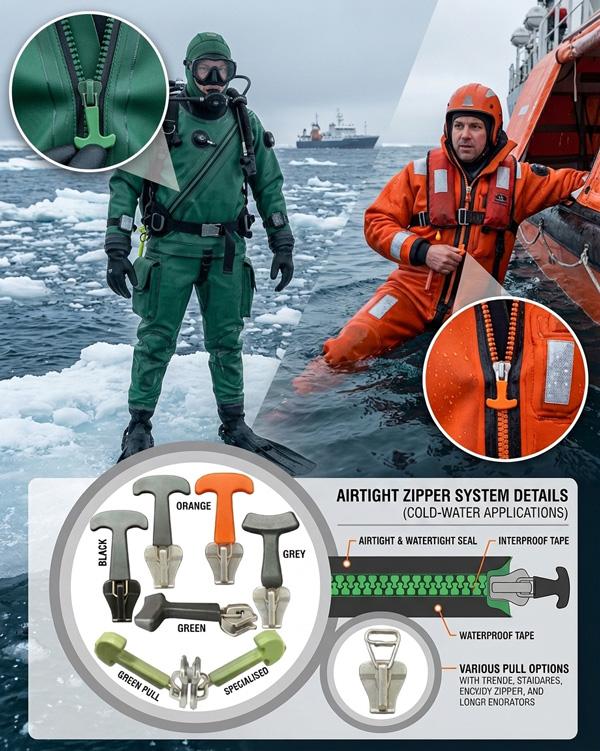
Airtight Zipper Selection at a Glance
| Evaluation Area | Drysuit | Marine Immersion Suit | What the Buyer Should Prioritize |
|---|---|---|---|
| Typical users | Recreational, technical, commercial, scientific, and public-safety divers | Crew members, fishers, offshore workers, and passengers | Routine use by trained divers versus emergency use by people with different experience levels |
| Use pattern | Frequent donning, diving, cleaning, opening, and closing | Long-term storage with occasional drills and emergency deployment | Repeated-cycle durability versus immediate reliability after storage |
| Main environment | Cold water, salt water or fresh water, sand, silt, rocks, and diving equipment | Cold water, waves, salt spray, sunlight, deck contamination, oil, and humid storage | Salt exposure, low temperature, UV weathering, contaminants, and storage aging |
| Pressure and mechanical loads | Changing water pressure, suit-pressure management, repeated bending, and equipment loads | Water-entry impact, wave action, swimming, climbing, and boarding a survival craft | Sealing performance at a defined differential pressure plus reliability under real movement |
| Ergonomics | Suitable flexibility and controllable force during repeated operation | Glove-friendly grip, clear pull path, and unmistakable full-closure feedback | Slider operating force, puller strength, grip design, and final-seal confirmation |
| RHF construction options | Nylon-tooth, molded plastic (resin)-tooth, or toothless construction with TPU-coated tape | Verify the exact series, size, slider, end seal, and test conditions | |
| Final validation | Leak and movement testing on the installed drysuit | Donning, movement, water-ingress, and applicable approval testing on the complete suit | Component data does not replace finished-garment testing |
Start with the Real Marine and Underwater Environment
Salt Water, Salt Spray, and Corrosion
Salt water can corrode the slider, puller connection, and other exposed hardware. When seawater dries, salt crystals can remain around the teeth, slider, sealing track, and end seal. This contamination can increase operating force, abrade sealing surfaces, and prevent the slider from reaching its fully closed position.
UV Exposure and Weathering
Marine workers can experience extended sunlight exposure on open decks and survival craft, while water can reflect additional UV radiation. NIOSH identifies ultraviolet exposure as one of the physical hazards faced by marine transportation workers. For zipper specifications, the useful engineering terms are UV resistance and weathering resistance, not the broader term “radiation resistance.” See the CDC/NIOSH overview of marine transportation hazards.
Underwater Pressure and Dynamic Loading
Ambient water pressure increases with diving depth, so sealing strength is an important drysuit sourcing criterion. However, a diver manages the gas inside a drysuit through inflation and exhaust valves. The zipper therefore experiences a differential pressure across the garment together with bending, body movement, localized tension, and equipment loads. A supplier’s zipper pressure rating should not be converted directly into a universal maximum diving depth.
Cold, Sand, Oil, and Humid Storage
Low temperature can change flexibility and operating feel. Sand or silt can enter the teeth, slider, or sealing track. Fuel, lubricants, and cleaning agents may affect the TPU-coated tape, bonding system, or suit material. Long-term humid storage can contribute to hardware corrosion, TPU aging, adhesive deterioration, and permanent deformation. Each relevant exposure should be translated into a defined test or acceptance requirement.
1. Can the Sealing Strength Meet the Intended Depth and Pressure Conditions?
A drysuit used at greater depth operates in a higher-pressure environment. An immersion suit must withstand water entry, continued immersion, wave action, and wearer movement. In both cases, pressure and leakage performance should be defined before the zipper is ordered.
Ask the supplier to state:
- Whether the result covers airtightness, watertightness, or both;
- The test medium and differential test pressure;
- The pressure-hold time and permitted leakage rate or pass/fail criterion;
- The sample orientation and whether it was flat, bent, or installed in a panel;
- Any saltwater, low-temperature, bending, or cycling preconditioning; and
- The exact teeth or sealing track, slider, tape, end seal, length, and configuration tested.
This zipper configuration was tested with [test medium] at [differential pressure] for [time], in [sample condition and orientation], with an acceptance criterion of [leakage limit or pass/fail definition].
Separate three levels of evidence: a loose zipper tested in a fixture, a zipper-to-fabric seam test, and a complete-garment leak or water-ingress test. None of these automatically replaces the others.
Warning sign: Claims such as “deep-diving zipper,” “high-pressure waterproof,” or “100% waterproof” without a test method and acceptance limit.
2. Should You Choose Nylon Teeth, Molded Plastic Teeth, or a Toothless Airtight Zipper?
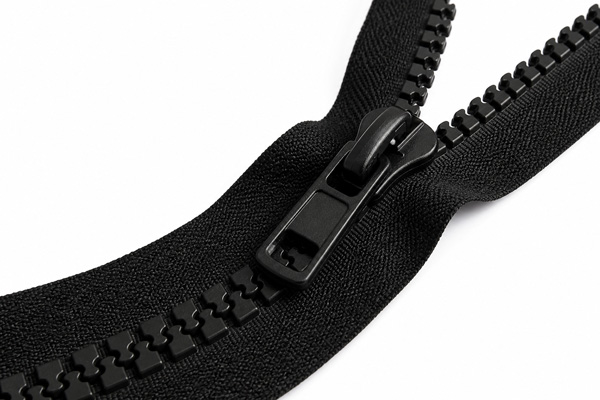
RHF airtight zipper options include nylon-tooth, molded plastic—often called resin-tooth—and toothless constructions with TPU-coated tape. These systems do not close in the same way and should be selected according to the required seal, flexibility, operating feel, garment layout, and service environment.
- Nylon-tooth airtight zipper: Confirm the tooth construction, size, crosswise strength, flexibility, and sealing performance after saltwater exposure, cold conditioning, and repeated operation.
- Molded plastic or resin-tooth airtight zipper: Confirm tooth engagement, slider compatibility, bending performance, low-temperature impact resistance, and post-cycle sealing stability.
- Toothless airtight zipper: Confirm sealing-track strength, closing feel, terminal-seal design, contamination tolerance, and reliability after flexing.
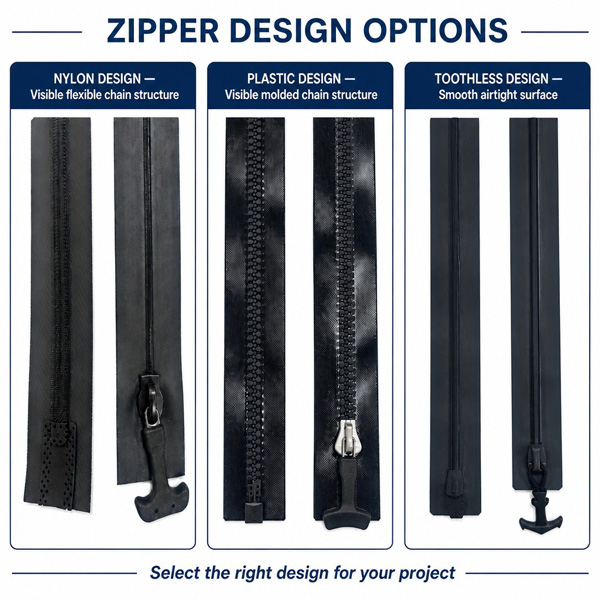
The construction name alone does not prove performance. Confirm the slider, puller, base tape, TPU surface layer, terminal seals, dimensions, and test report for the exact item being quoted. For current series, sizes, and construction details, visit the RHF airtight zipper product page.
Warning sign: A supplier says all three constructions perform the same and should be selected only by price.
3. Can the TPU-Coated Tape and Zipper Components Withstand the Actual Marine Environment?
“Marine grade” is not a complete specification. The buyer should identify the exposures that apply to the garment and request results after relevant conditioning.
| Exposure | What to Define or Request |
|---|---|
| Salt water and salt spray | Concentration, duration, wet/dry cycles, corrosion observations, operating force, and sealing result after exposure |
| UV and sunlight | UV or artificial-weathering method plus changes in appearance, strength, flexibility, and sealing |
| Low temperature | Minimum operating temperature, conditioning time, operating force, impact behavior, and sealing at temperature |
| Heat and humidity | Temperature, relative humidity, exposure time, and post-aging condition of the TPU layer, adhesive, and end seals |
| Sand, silt, and particles | Contamination location, cleaning method, and operation and leakage results after contamination or cleaning |
| Fuel, oil, and cleaning agents | Exact chemical, concentration, contact time, and post-exposure performance |
A realistic sequence can be more informative than separate tests—for example: saltwater exposure → fresh-water rinse → cold conditioning → repeated operation → operating-force and leakage testing.
Warning sign: “Saltwater resistant,” “oil resistant,” or “marine grade” without a defined exposure and post-exposure result.
4. Can the Wearer Fully Close the Zipper While Wearing Gloves or Working in the Cold?
An airtight zipper generally requires more deliberate operation than an ordinary garment zipper because the slider must correctly engage the teeth or sealing track and complete the terminal seal. The goal is not the lowest possible pull force. The goal is a controllable force that allows the user to move the slider through its full travel and confirm complete closure.
Evaluate two separate properties:
- Slider operating force: the force required to move the slider and complete the seal.
- Puller strength: the load the puller and its connection can withstand before permanent deformation or failure.
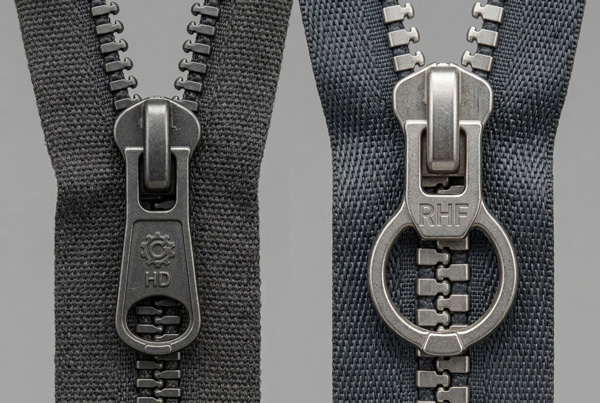
A T-shaped puller is a common option because its crossbar can be easier to grip with wet or insulated gloves. However, a T-puller is not proof of airtightness and is not automatically the best choice for every garment. Its size must provide a secure grip without creating an unnecessary snagging hazard.
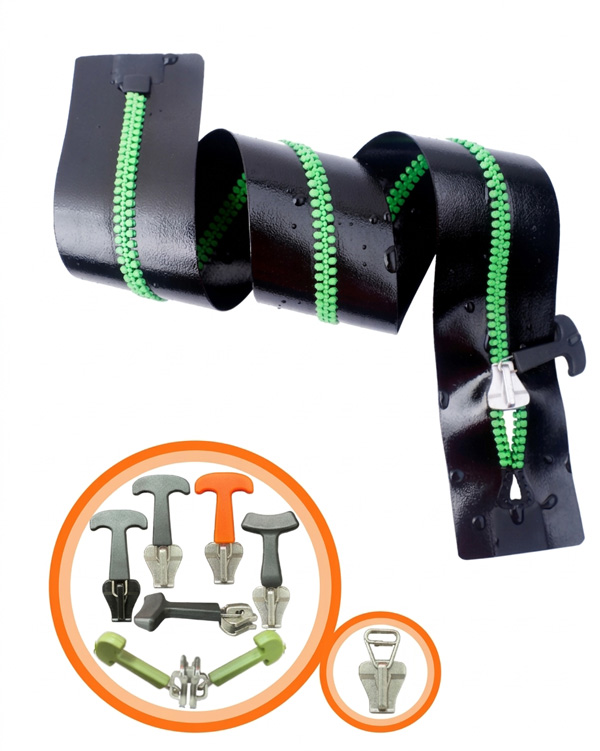
Test whether the puller can be located and gripped with wet or thick gloves, whether the pull direction stays aligned with the zipper path, whether operating force remains controllable after cold and contamination conditioning, and whether the user receives clear visual or tactile feedback when the slider reaches the final seal.
An immersion suit prioritizes fast donning and complete closure in an emergency. A drysuit prioritizes reliable donning before the dive, controlled operation during repeated use, and normal removal after the dive. A drysuit is not designed to be rapidly removed underwater as an escape method.
For current slider and puller options, see the RHF airtight zipper product page.
Warning sign: Puller strength is offered as proof of easy operation, or a short flat sample is used to demonstrate the operating force of a full installed zipper.
5. Are the Flexibility and Minimum Bend Radius Suitable for the Garment Pattern?
A diagonal front-entry drysuit, a shoulder-entry drysuit, and a front-entry immersion suit place the zipper along different body paths. A zipper that is too stiff can restrict movement and transfer stress into the TPU-coated tape, bond line, or garment fabric. Excessive bending, however, can damage teeth, sealing tracks, sliders, and terminal seals.
Ask the supplier to define:
- The recommended minimum bend radius;
- Whether the zipper may be rolled and which folding methods are prohibited;
- Installation restrictions across the chest, shoulder, back, or waist;
- Operating force and leakage after bend cycling; and
- Areas that must not be compressed by a harness, cylinder, weight system, or other equipment.
Flexibility should never be evaluated separately from sealing stability, crosswise strength, and operating force. The correct zipper balances wearer movement with the mechanical support needed to maintain the seal.
Warning sign: A supplier demonstrates flexibility with a short loose sample but provides no minimum bend radius or installed-garment evidence.
6. Is the Zipper Designed for Frequent Cycling or Long-Term Emergency Storage?
Drysuits and immersion suits can fail for different lifecycle reasons. A drysuit zipper may wear through frequent opening, closing, bending, rinsing, and contamination. An immersion suit zipper may deteriorate because it has remained folded and unused in a humid environment for years.
For Frequently Used Drysuits
- Confirm the specified opening-and-closing cycle count.
- Check wear of the slider, teeth, or sealing track.
- Review performance after salt, sand, bending, and cleaning.
- Compare operating force and leakage before and after cycling.
For Stored Immersion Suits
- Test the first opening and closing after long-term humid or folded storage.
- Inspect aging of the TPU layer, bond line, terminal seals, and hardware.
- Check for blocking, sticking, corrosion, or permanent deformation.
- Verify immediate operation after cold storage or cold conditioning.
A cycle count has limited value unless the test temperature, zipper length, sample installation, operating load, and post-cycle leakage result are also stated.
Warning sign: Unsupported promises such as “thousands of cycles with no degradation” or “stored for years and seals on the first pull.”
7. Are the Length, Tape Width, Opening Style, Slider, and Terminal Seals Correct?
Two zippers described as “No. 10, 800 mm” may still have different usable openings, tape widths, installation margins, slider directions, and terminal seals. A configuration error can make the garment difficult to enter, prevent full closure, or overload the zipper-to-fabric seam.
Approve a dimensional drawing that identifies:
- Zipper size, closed-chain width, ordered length, and measurement reference points;
- Usable opening length, total TPU-coated tape width, and usable installation area;
- Tooth-free end margins and reinforcement areas;
- Open-end, closed-end, single-open, two-way, or other configuration;
- Slider direction, slider material, locking function, and puller design;
- Top stop, bottom stop, and terminal-seal construction; and
- Dimensional tolerances and inspection method.
Front-entry drysuits may prioritize self-donning and torso flexibility. Rear-entry designs may provide a straighter zipper path but often require assistance. Immersion suits generally benefit from a clear front closure that can be found and operated quickly while wearing gloves.
Warning sign: The quotation lists only the size, color, and overall length, with no approved drawing or measurement definition.
8. Is the TPU Zipper Tape Compatible with the Suit Material and Installation Process?
A zipper that passes a component leak test can still fail after installation. The bond line, welded seam, stitched-and-sealed seam, and transitions at the zipper ends are all part of the finished sealing system.
Drysuits and immersion suits use different rubberized, coated, or laminated fabrics. Although the RHF airtight zipper systems discussed here use TPU-coated tape, TPU formulation, base fabric, garment surface, adhesive, and processing parameters can vary. Material names alone do not prove compatibility.
Confirm:
- The approved bonding, welding, sewing-and-sealing, or other installation method;
- Recommended adhesive, primer, temperature, pressure, dwell time, and preparation procedure;
- Peel or seam strength using the actual production materials;
- Connection performance after saltwater, heat/humidity, cold, UV, and chemical conditioning;
- End reinforcement and stress control in bending areas; and
- Leak performance of a garment made with production equipment and production processes.
A 2026 U.S. Coast Guard safety alert described adhesive failures between immersion-suit main zippers and suit bodies and warned that visual inspection may not always reveal the problem. Read USCG Safety Alert 03-26.
Warning sign: “Both surfaces are TPU, so they can automatically be welded together” without a documented process trial.
9. Can the Supplier Provide Configuration-Specific Testing, Traceability, Maintenance, and Repair Support?
The buyer is not approving an isolated sample. The buyer is approving a safety-related component that must be produced consistently, installed correctly, inspected, maintained, and replaced when necessary.
Test Evidence Should Identify
- The manufacturer, laboratory, product number, and revision;
- The tooth or toothless construction, size, length, TPU-coated tape, slider, puller, and end configuration;
- The number of specimens and their installation condition;
- The test method, medium, pressure, time, and temperature;
- Any saltwater, UV, cold, heat/humidity, chemical, or cycle preconditioning; and
- Leakage, operating-force, strength, and appearance acceptance criteria.
Production Control Should Cover
- Batch traceability to material and inspection records;
- Dimensional, operating, and sealing checks performed on each batch;
- Whether 100% leak testing is required or available;
- Customer notification before changing materials, TPU tape, sliders, tooling, end seals, or processes; and
- Prototype, pilot-run, mass-production, and replacement lead times.
Maintenance and Service Instructions Should State
- How to rinse and clean the zipper after saltwater use;
- Which lubricant, if any, is approved for the exact model, where it is applied, and how often;
- Which lubricants, powders, cleaners, and chemicals are prohibited;
- The required storage position, packaging method, and bend restrictions;
- Inspection and pressure-test intervals; and
- Which damage may be repaired under an approved procedure and which requires complete zipper replacement.
Do not apply one generic cleaning, lubrication, or repair instruction to every nylon-tooth, molded plastic-tooth, and toothless zipper. Do not recommend zipper wax, silicone oil, or repair adhesive unless it is approved for that exact zipper and garment system.
Warning sign: The supplier uses a report for a different length, slider, tape, end seal, or construction to approve the quoted zipper.
Airtight Zipper RFQ Checklist
Include the following information when requesting a recommendation and quotation:
- Garment type, wearer, and donning method;
- Target market and applicable finished-garment requirements;
- Intended diving depth or surface-immersion conditions;
- Test medium, differential pressure, hold time, and leakage limit;
- Saltwater, salt spray, UV, cold, heat/humidity, sand, oil, and chemical exposure;
- Preferred nylon-tooth, molded plastic or resin-tooth, or toothless construction;
- Expected operating cycles and maximum storage period;
- Installation path, minimum bend radius, size, length, tape width, usable opening, and end margins;
- Slider direction, slider material, and puller design;
- Garment material and intended installation process;
- Environmental-aging, cycling, strength, and finished-garment validation plan;
- Batch traceability, change control, and leak-test requirements; and
- Cleaning, lubrication, storage, inspection, and repair requirements.
Final Sourcing Recommendation
Do not approve an airtight zipper only because it looks robust, has nylon or molded plastic teeth, uses TPU-coated tape, includes a T-shaped puller, or carries a general “waterproof,” “airtight,” or “marine” description. These are configuration features—not proof that the zipper is suitable for a particular drysuit or immersion suit.
A zipper should enter the formal approval process only when five questions can be answered with evidence:
- Does its sealing strength meet the agreed pressure and leakage requirements?
- Can it withstand the actual saltwater, UV, cold, contamination, bending, and storage environment?
- Can the intended wearer close it completely while wearing the required gloves and clothing?
- Does the installed zipper-to-fabric seam—and the finished suit—remain reliable?
- Can the supplier repeatedly deliver the approved construction with testing, traceability, maintenance guidance, and replacement support?
Need More Airtight Zipper Details?
Review RHF’s current airtight zipper series, available sizes, sealing configurations, installation options, slider and puller choices, and customization capabilities on the product page.
For a project-specific recommendation, provide the garment application, intended depth or pressure, zipper path, material construction, installation process, environmental exposures, target requirements, quantity, and validation plan.