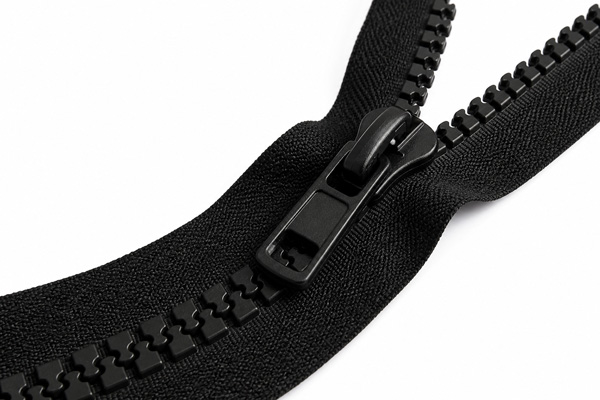
5 Best Heavy-Duty Zippers for Outdoor Gear
For most exposed outdoor gear, the best starting point is a No. 10 molded acetal zipper with UV-stabilized polyester tape and corrosion-resistant slider hardware. A coated reverse-coil zipper is better for rain-exposed flexible panels, an uncoated polyester coil for tight curves, a corrosion-controlled metal zipper for dry high-abrasion use, and an engineered pressure-sealing zipper when verified watertight or airtight performance is required.
There is no single zipper that is best for every outdoor product. The correct choice depends on the dominant exposure—UV, salt, low temperature, rain, immersion, sand or repeated flexing—and on how the zipper performs after it is installed in the production fabric.
This article is an outdoor-application comparison, not another general introduction to heavy-duty zippers. For terminology, component construction and industrial zipper categories, use our complete heavy-duty industrial zipper buyer’s guide. For the universal process of turning an application into an RFQ, use How to Choose the Best Heavy Duty Zipper for Your Project.
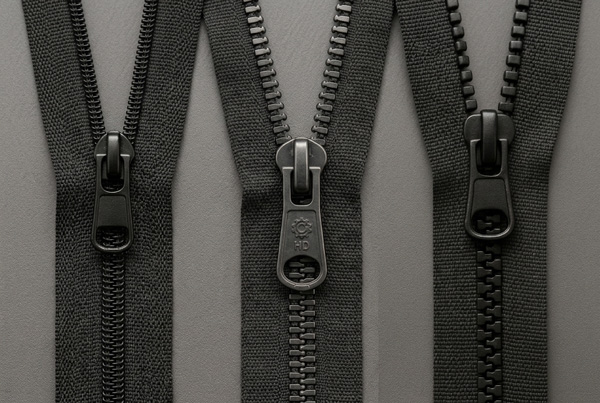
Quick Comparison: Which Heavy-Duty Zipper Fits Which Outdoor Program?
| Rank | Zipper system | Best starting application | Main advantage | Main limitation |
|---|---|---|---|---|
| 1 | No. 10 molded acetal zipper | Tents, shelters, exposed equipment covers and large outdoor bags | Strong element engagement without metal-tooth corrosion | Stiffer on tight curves; not inherently watertight |
| 2 | No. 8 or No. 10 PU/TPU-coated reverse coil | Outdoor workwear, rain covers and flexible access panels | Lower rain entry with good flexibility | Coating, stitching and endpoints remain possible leak paths |
| 3 | No. 8 or No. 10 high-tenacity polyester coil | Curved protective cases, packs and frequently folded panels | Smooth operation and good bend compliance | Must be protected from excessive cross-chain and peel loads |
| 4 | No. 10 corrosion-controlled metal zipper | Dry, abrasive equipment cases and selected heat-exposed products | High abrasion resistance and robust tooth engagement | Heavier; corrosion and galvanic compatibility require validation |
| 5 | Engineered watertight or airtight sealing zipper | Immersion-rated marine, rescue and pressure-control equipment | Can meet defined leakage or pressure requirements as a complete system | Highest cost and installation sensitivity; performance is specification-specific |
This table identifies a starting configuration, not a purchase approval. Gauge numbers are nominal size references, not universal strength grades. Two zippers carrying the same gauge can produce different results because of their chain geometry, tape, slider, stops, material formulation and manufacturing tolerance.
How We Ranked the Five Outdoor Zipper Systems
We ranked complete zipper systems rather than isolated tooth materials. Each configuration was assessed against five manufacturing questions:
- Does the chain remain operable after the expected environmental exposure?
- Does the complete assembly resist the project’s cross-chain, puller, stop and slider loads?
- Can it follow the product’s seam path without creating excessive operating force?
- Can the supplier repeat the approved construction across production lots?
- Can the required result be verified with a documented test method and production-intent sample?
Price was not used as a stand-alone performance indicator. Nor did we treat labels such as “marine grade,” “all-weather” or “industrial strength” as evidence unless the proposed item code was connected to a bill of materials, test conditions and acceptance criteria.
1. No. 10 Molded Acetal Zipper: Best Overall for Exposed Outdoor Equipment
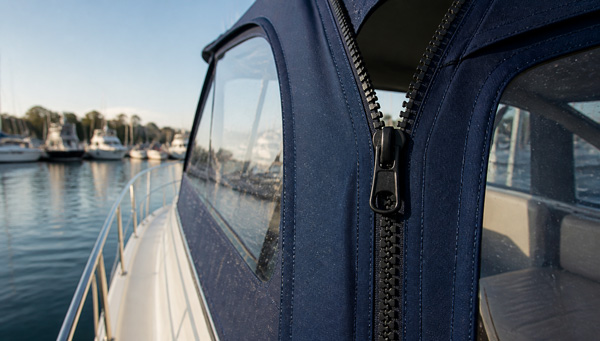
A No. 10 molded acetal system is the strongest general starting point for long, exposed openings on tents, shelters, equipment covers and large outdoor bags. The molded elements resist rust, shed moisture more readily than many untreated metal constructions and provide positive engagement under normal panel tension.
Recommended Production Configuration
- No. 10 molded acetal chain
- UV-stabilized, high-tenacity polyester tape
- Acetal or corrosion-resistant metal slider selected for the same chain profile
- Non-corroding top and bottom components
- Locking or non-locking slider based on the access design
- Enlarged puller only after puller strength and snag risk are evaluated
Why It Ranks First
This configuration balances outdoor exposure, chain strength, cost and production repeatability better than the more specialized options below. It is also available in open-end, closed-end, two-way and continuous-chain constructions, allowing one material family to support multiple SKUs when the individual assemblies are separately approved.
Limitations and Procurement Risks
- It becomes less suitable as the seam radius tightens. A chain that runs smoothly while flat may bind after it is sewn around a corner.
- The teeth can resist water without making the installed closure watertight. Water may enter through the element gaps, tape, stitching or zipper ends.
- Cold performance depends on the complete construction. Acetal elements, tape, slider, stops and surrounding panel must be operated at the project’s minimum temperature before approval.
- Oversizing the chain can increase stiffness and operator force without resolving a weak seam or poorly positioned stress point.
Production-floor observation: Binding often appears only after sewing, when asymmetric stitch tension twists the two stringers. Evaluate slider force on the installed pilot assembly, not only on loose zipper samples.
Evidence to request: exact item specification, material declaration, baseline zipper strength results, conditioned low-temperature operation, weathering protocol and post-exposure strength or operating-force results.
2. No. 8 or No. 10 Coated Reverse-Coil Zipper: Best for Rain-Exposed Flexible Panels
A PU- or TPU-coated reverse-coil construction is a better choice when rain shedding, appearance and panel flexibility matter more than maximum chain stiffness. Typical programs include outdoor workwear, soft equipment covers and access panels that must fold repeatedly.
The coating covers the exposed face of the coil and reduces direct water entry through the chain. It does not, by itself, prove that the zipper or finished product is waterproof.
Recommended Production Configuration
- No. 8 or No. 10 reverse coil selected from installed-load testing
- PU or TPU coating with a defined chemistry, thickness and surface finish
- Tape compatible with the product’s sewing, welding or bonding process
- Slider geometry matched to the coated chain to avoid coating abrasion
- Reinforced end design where the slider changes direction or reaches a stop
Advantages
- Better flex response than a large molded chain on soft panels
- Lower rain entry than an equivalent uncoated coil when properly installed
- Clean exterior surface for branded outdoor products
- Suitable for repeated folding when the coating remains flexible at the use temperature
Limitations and Procurement Risks
- Needle holes, seam construction and zipper ends can become the dominant leak path.
- Some coatings stiffen, whiten, crack or delaminate after cold flexing, UV exposure, hydrolysis or abrasion.
- A slider that is too tight can wear through the coating before the coil itself fails.
- Coating color and gloss may vary if the approved formulation or process changes between lots.
Production-floor observation: In rain-resistance programs, the first leak frequently appears beside the zipper or at an endpoint rather than through the coated center section. Test the complete sewn or welded panel in its production orientation.
Evidence to request: coating formulation identifier, coating adhesion or flex results, cold-conditioned operation, post-weathering appearance and function, and a finished-panel water-ingress report with pressure, duration and specimen orientation stated.
3. No. 8 or No. 10 High-Tenacity Polyester Coil: Best for Curves and Repeated Flexing
A high-tenacity coil zipper is usually the best option for curved protective cases, outdoor packs and flexible panels that are folded during assembly, transport or operation. Its continuous coil follows changing geometry with less local resistance than a large molded or metal chain.
An Important Specification Detail
Many commercial RFQs use “nylon coil zipper” as a category name. The actual monofilament, sewing thread and tape may be polyester, polyamide or a combination. Require the supplier to identify the material of each critical component instead of approving the category name alone.
Advantages
- Smooth operation around moderate curves
- Lower mass and bulk than many No. 10 molded or metal systems
- Efficient continuous-chain production for long or variable openings
- Good compatibility with soft, repeatedly folded structures
Limitations and Procurement Risks
- Coil stitching and tape attachment become critical load paths.
- Concentrated cross-chain load can distort the coil or transfer failure into the seam.
- Sand and fine contamination can increase slider wear and operating force.
- An uncoated coil provides access closure, not a water seal.
Evidence to request: chain and slider compatibility data, coil attachment inspection criteria, cycle testing on the intended curve, contamination testing where sand or mud is expected, and post-cycle inspection of the coil stitching.
4. No. 10 Corrosion-Controlled Metal Zipper: Best for Dry, Abrasive Outdoor Use
Metal zippers remain valuable where tooth abrasion, rugged engagement or elevated-temperature exposure has greater priority than weight and corrosion resistance. Appropriate applications can include dry-climate equipment cases, selected tool-carrying products and covers used away from sustained salt or moisture.
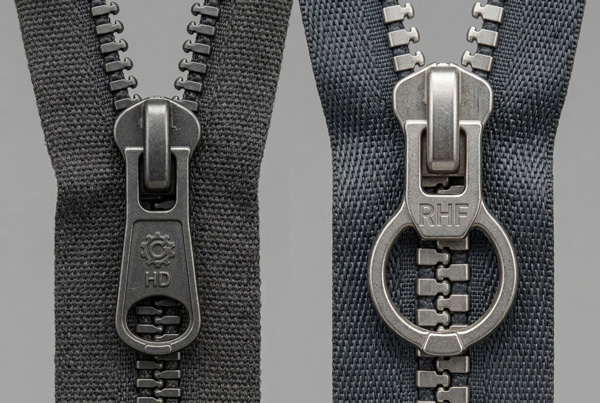
“Metal” is not one specification. Brass, nickel silver, aluminium and stainless constructions have different mass, corrosion behaviour, finishes and compatibility with sliders and stops. The complete metal combination must be disclosed.
Advantages
- Robust individual teeth in abrasive handling conditions
- Strong tactile engagement for heavy panels
- Options for projects where a polymer chain is unsuitable for the defined temperature exposure
Limitations and Procurement Risks
- Untested metal combinations can corrode or create galvanic interactions in salt and humidity.
- Metal adds weight and may increase operating force on long openings.
- Dirt, salt crystals and ice can obstruct the slider channel.
- A salt-spray exposure result does not predict a specific number of years outdoors.
- The tape and sewing thread may fail from heat or weather even when the teeth remain intact.
Use ASTM B117 or ISO 9227 only as controlled corrosion-exposure methods with project-defined specimens, duration and evaluation criteria. Both standards leave product-specific exposure periods and result interpretation to the applicable specification; ISO 9227 also warns against using the test to predict long-term outdoor corrosion.
Evidence to request: metal composition or finish declaration for teeth, slider and stops; corrosion test conditions; visual rating; operating force and functional test after exposure; and confirmation that no unapproved material substitution will occur.
5. Engineered Watertight or Airtight Zipper: Best for Immersion and Pressure-Controlled Equipment
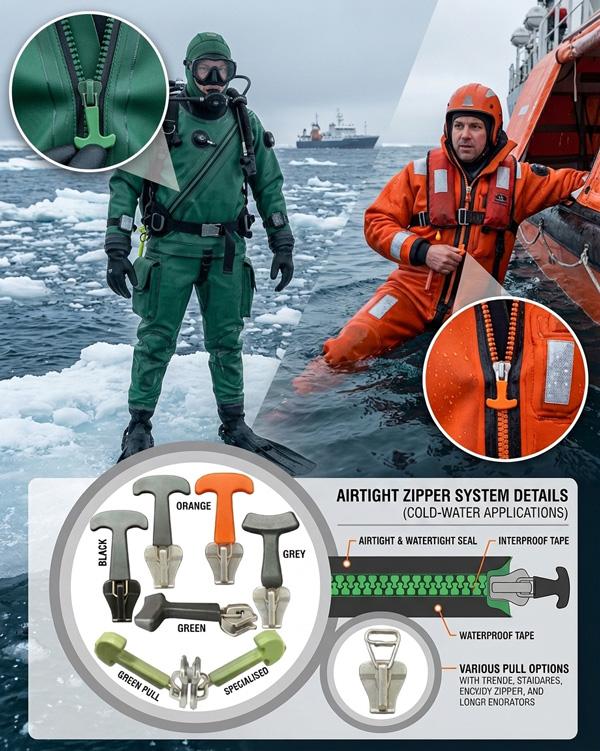
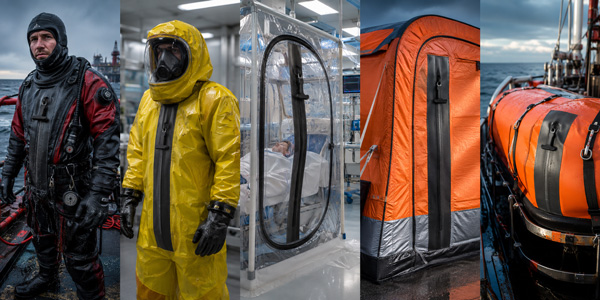
When a marine, rescue or protective product must control leakage under immersion or pressure, a standard coated zipper is not enough. The project needs an engineered sealing zipper whose claimed performance is tied to a defined assembly, closure direction, pressure, duration and cycle requirement.
This category may use coated or elastomeric sealing surfaces, specialized chain geometry, dedicated sliders and controlled installation processes. It should be treated as a functional subsystem, not as a cosmetic zipper upgrade.
Advantages
- Can be engineered for measurable water or air leakage limits
- Suitable for high-consequence applications when the complete assembly is qualified
- Provides a defensible specification when the test method and acceptance threshold are stated
Limitations and Procurement Risks
- Higher material, validation and installation cost
- Greater stiffness and operating-force sensitivity
- Specialized storage, cleaning, lubrication or closing procedures may apply
- Tooling, sample and production lead times can be longer than standard zipper programs
- The zipper rating does not automatically qualify the finished product or its seams
Do not describe a loose zipper as “IPX7 certified” merely because it is intended for a wet product. IEC 60529 classifies protection provided by electrical-equipment enclosures; an IP result belongs to the tested enclosure configuration, not automatically to an unattached zipper component.
Evidence to request: the exact leak or pressure test method, specimen drawing, pressure differential, duration, orientation, number of cycles, conditioning, pass/fail limit, installation instructions and production lot traceability.
Outdoor Environment Decision Matrix
| Dominant exposure | Preferred starting system | What must be verified | Usually avoid unless separately proven |
|---|---|---|---|
| Long-term UV and dry heat | UV-stabilized molded acetal or qualified coil | Tape, resin, coating and color retention after the defined weathering cycle | Unstabilized resin, unknown dye or coating formulation |
| Coastal salt and humidity | Molded acetal or qualified coil with corrosion-resistant slider and stops | Every metal component after corrosion conditioning; post-exposure operation | Untreated metal chain or mixed hardware approved only by appearance |
| Alpine cold and repeated flexing | Cold-qualified coil or molded system | Operation while conditioned, coating flex, tape cracking and slider force | Coating or polymer approved only at room temperature |
| Sand, dust and abrasion | Molded acetal or qualified metal system, depending on moisture | Contaminated cycle test, cleaning method and slider wear | Tight coated slider interfaces without abrasion evidence |
| Tight curves and folding panels | High-tenacity coil | Installed bend radius, seam tension and cycle life | Oversized rigid chain around sharp corners |
| Rain splash | Coated reverse coil plus engineered seam | Finished-panel leakage, endpoints and needle holes | Marketing claims based only on coating appearance |
| Immersion or controlled air leakage | Engineered sealing zipper | Complete installed leak or pressure test | General water-resistant chain |
For mixed environments, rank the failure consequences rather than averaging the exposures. A coastal rescue product may require cold operation, salt conditioning and leakage control in sequence. One room-temperature strength result cannot represent that duty profile.
Test the Zipper After Outdoor Conditioning, Not Only Before It
The most useful outdoor validation program compares the same performance characteristics before and after exposure. A zipper can pass an initial strength test and still become brittle, corroded, difficult to operate or prone to leakage after conditioning.
Stage 1: Establish Baseline Performance
Record the exact zipper item code, revision, lot, component materials and specimen construction. Depending on the failure risks, baseline testing may include chain strength, stop holding, slider pull-off, slider locking and other methods in ASTM D2061, plus relevant operability methods in ASTM D2062.
ASTM D2061 does not assign one universal outdoor pass value. Its own scope states that no single test determines suitability for a specific end use. The buyer and finished-product engineer must therefore define the required tests and acceptance values for the proposed zipper assembly.
Stage 2: Condition Production-Intent Specimens
- UV and moisture: Use a documented laboratory weathering protocol appropriate to the materials. ASTM G154 provides procedures for fluorescent UV exposure, while ASTM G155 covers xenon-arc apparatus. Report lamp type, irradiance, temperature, moisture cycle, duration and control material.
- Corrosion: Use ASTM B117 or ISO 9227 when relevant to metallic teeth, sliders, stops or finishes. Define the exact specimen and evaluation method before testing.
- Low temperature: Condition the complete assembly at the project minimum and operate it while cold. Inspect coating, tape, elements, stops and slider rather than evaluating one resin in isolation.
- Rain or immersion: Test the installed zipper, endpoints, seam and surrounding material at the specified orientation, pressure and duration.
- Sand or mud: Apply a repeatable contamination and cleaning sequence, then measure slider force, functional cycling and damage.
Stage 3: Repeat Functional Tests and Inspect the Failure Mode
After conditioning, repeat the agreed strength, operating-force, cycling and leakage checks. Report property retention and the location of failure. “Passed weathering” is incomplete if the report does not show what was measured after exposure.
Stage 4: Validate the Installed Pilot Lot
Test production-intent zippers in the real panel material with the intended seam allowance, reinforcement, thread, slider direction, endpoints and operating load. The loose zipper, sewn subassembly and finished product answer different engineering questions; critical outdoor programs may require all three.
Batch Consistency Requirements for Long Outdoor Programs
Outdoor failures can appear months after delivery, so repeat orders need stronger controls than visual inspection of a shipment sample.
Freeze the Approved Construction
The signed specification should identify, as applicable:
- Chain family, nominal gauge and profile
- Element or monofilament material
- Tape fibre, width, weave and finish
- UV stabilizer or coating formulation reference
- Slider model, material, finish and locking function
- Top and bottom components
- Finished length and project-specific tolerances
- Color reference and approved measurement method
- Packaging and storage limits for coated or sealing products
Any change to resin, stabilizer package, tape yarn, dye process, coating, slider alloy, finish, tooling or subcontractor should trigger documented review. Changes affecting outdoor performance require requalification, not only a new appearance sample.
Use Risk-Based Incoming and Lot Inspection
ISO 2859-1:2026 can provide AQL-indexed sampling plans for inspection by attributes. The buyer still has to define lot formation, critical, major and minor defects, inspection level and switching rules. AQL sampling is not a substitute for engineering validation, and a zero-critical-defect requirement may require controls beyond routine sampling.
| Control point | Routine lot evidence | Periodic or change-triggered evidence |
|---|---|---|
| Identity and traceability | Item code, revision, lot code and production date | Supplier and raw-material trace review |
| Dimensions | Chain width, tape width, finished length and approved tolerances | Measurement-system review |
| Function | Slider travel, stops and separable operation where applicable | Extended cycle and installed-panel trial |
| Strength | Buyer-selected ASTM D2061 characteristics | Full qualification set after design or material change |
| Coating or sealing surface | Appearance, adhesion indicator and handling damage | Weathering, cold flex and leakage testing |
| Corrosion resistance | Hardware identity and finish verification | ASTM B117 or ISO 9227 exposure on the approved assembly |
| Color | Approved visual or instrumental comparison | Lightfastness or weathering where color retention is critical |
Retain signed pre-production samples and lot samples for the period defined by the product’s warranty and investigation needs. For the first production lots or after a change, tightened inspection is more defensible than assuming the approved development sample represents stable mass production.
Outdoor OEM Customization: What Can Change Without Re-Engineering the System?
Low-risk options can include packaging, puller branding and colors already validated within an approved material system. Even these changes require a sample when they affect weight, slider balance, snag risk, dye chemistry or surface temperature.
Changes to chain geometry, element resin, UV stabilizers, tape construction, coating chemistry, slider material, stops or sealing surfaces are engineering changes. They can alter strength, low-temperature flexibility, corrosion behaviour, leakage and cycle life, and must be requalified against the outdoor program.
MOQ and lead time should be quoted for the approved configuration rather than presented as universal factory numbers. Custom dyeing, coating, metal finishes, tooling, third-party tests and dedicated production runs each change the commercial threshold. Seasonal outdoor launches should reserve time for specification review, production-intent samples, laboratory conditioning, pilot assembly and corrective action before the bulk-production window.
Customer Feedback on Custom Zipper Samples and Product Quality
The following anonymized screenshots document customer experience with zipper sample selection and received product quality. They are included as supplier-experience evidence and are not used as technical proof of outdoor durability, load capacity, water resistance or long-term field performance.
Sample Feedback: No. 30 Resin Zipper and Oversized Zipper Options
During sample evaluation, the customer stated that the No. 30 resin zipper was the size being sought and asked about available colors for trial quantities. The same conversation also asked whether the largest metal zipper shown in a product video was available. After receiving the samples, the customer described them as “perfect” and requested pricing for 100 units.
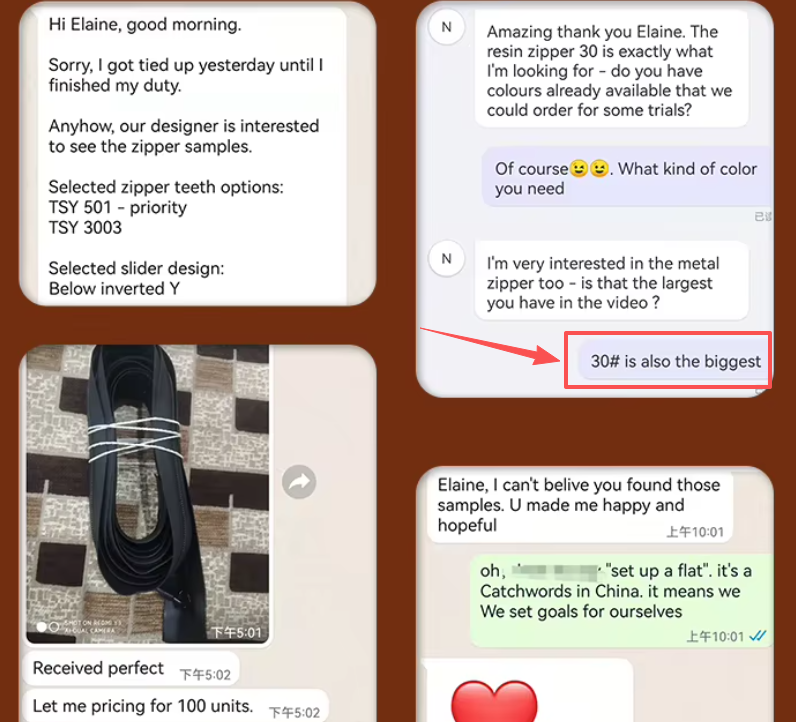
Evidence boundary: This feedback supports sample matching, size availability and purchase interest. The conversation does not identify an outdoor application or provide mechanical, environmental or production-lot test results.
Product Feedback: Good Quality After Delivery
The second group of customer messages describes received zipper products as “very good quality,” “super,” “all perfect” and “amazing.” This is useful evidence of customer satisfaction with delivered samples or products, while remaining separate from the technical qualification of a specific heavy-duty outdoor zipper system.
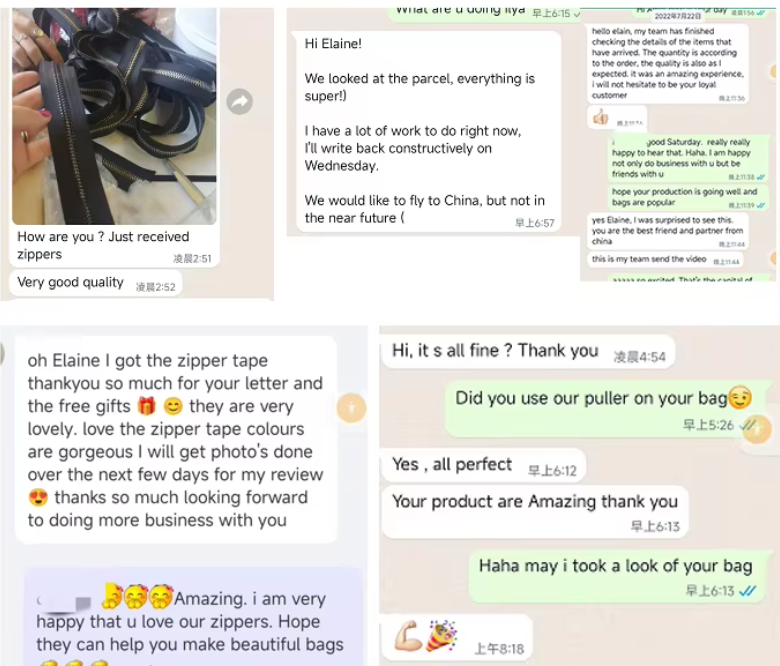
Evidence boundary: The messages do not identify the zipper gauge, component materials, outdoor application, test method or operating conditions. They should therefore be presented as general product-quality feedback rather than as proof of heavy-duty outdoor performance.
Five Costly Outdoor-Specific Procurement Mistakes
1. Approving Only Unconditioned Test Results
Baseline strength does not reveal UV embrittlement, coating cracks, salt corrosion or cold-operating problems. Require agreed measurements after the relevant exposure.
2. Treating Corrosion-Resistant Teeth as a Marine-Ready Zipper
The slider, puller, stops, coating, tape and stitching can become the first failure point. Review every exposed component.
3. Testing the Coated Center Section but Ignoring the Seam and Endpoints
A coating can reduce water entry through one part of the closure while the first production leak develops at needle holes, zipper ends or the surrounding seam. Test the installed panel rather than a short loose-chain specimen.
4. Converting Laboratory Hours into Years of Outdoor Life
ASTM G154, ASTM B117 and ISO 9227 define controlled exposures; they do not create a universal conversion from test hours to field years. Use comparative data, controls and relevant field history.
5. Using One Zipper Specification for Desert, Alpine and Coastal SKUs
The most damaging exposure changes by region. A common zipper family may still be possible, but each environment needs its own conditioned acceptance evidence and finished-product validation.
B2B Outdoor Zipper Approval Checklist
Before releasing a purchase order, confirm that the technical file answers all of the following:
- Is the exact chain, tape, slider, puller and stop construction identified?
- Is the dominant environment defined, including temperature, UV, salt, water and contamination?
- Are the installed loads, opening frequency and acceptable operating force documented?
- Are baseline tests connected to the proposed item code and production revision?
- Were production-intent samples conditioned for the relevant outdoor exposures?
- Were strength, operation and leakage checks repeated after conditioning?
- Was the zipper tested in the real panel, seam, endpoints and orientation?
- Are project-specific tolerances and defect classes on the signed specification?
- Is a golden sample approved and protected from uncontrolled substitution?
- Are lot traceability, change notification and requalification responsibilities agreed?
- Are MOQ, sampling, testing and delivery milestones tied to the actual customization?
- Does the compliance file match the destination market and buyer specification?
OEKO-TEX STANDARD 100 and REACH information can support chemical-compliance requirements, but neither proves outdoor mechanical durability. OEKO-TEX STANDARD 100 addresses harmful substances in textiles and accessories. REACH obligations depend on the substances, article and supply-chain role. Request them when the buyer or market requires them, and keep them separate from strength, weathering and leakage evidence.
B2B FAQ
Which Heavy-Duty Zipper Is the Best Starting Point for Commercial Tent Production?
A No. 10 molded acetal zipper with UV-stabilized polyester tape and corrosion-resistant slider hardware is a strong starting point for exposed, relatively straight tent openings. Use coil where tight curves or repeated folding dominate. Final approval should follow cold, UV, contamination and installed-panel testing appropriate to the tent program.
Is a Coated Reverse-Coil Zipper Waterproof?
Not automatically. It can improve rain resistance, but the supplier must state the tested construction and conditions. Waterproof, watertight and airtight describe different performance levels. The installed seam and endpoints must be included in the relevant leak test.
What Should a Buyer Request for a Coastal Outdoor Program?
Request the full material and finish specification for teeth or coil, slider, puller and stops; defined corrosion conditioning; post-exposure operation and strength results; UV evidence for tape and polymer parts; and lot-level change control. Do not accept “marine grade” as the complete technical specification.
How Should Low-Temperature Zipper Performance Be Approved?
Condition the production-intent assembly at the project minimum temperature, operate it while cold and inspect every component for cracking, deformation, excessive slider force and loss of engagement. Room-temperature testing after the sample has warmed up can miss the actual failure mode.
Can One Environmental Qualification Cover Every Zipper Color?
Not automatically. Dye and pigment packages can affect heat absorption, weathering response and material compatibility. A test program may use justified representative or worst-case colors, but the supplier and buyer should document why those samples cover the approved color range. A new color that changes resin, yarn, coating or dye chemistry requires technical review.
How Often Should Repeat Orders Be Re-Tested?
Routine lot checks should follow the signed control plan. Full environmental requalification is typically triggered by a material, process, tooling, supplier or design change and may also be scheduled periodically for long programs. The interval should reflect failure consequence, field exposure and the buyer’s quality system rather than an arbitrary order-volume threshold.
Final Recommendation
For most outdoor gear manufacturers, start with a No. 10 molded acetal system and move to a coated reverse coil, flexible polyester coil, corrosion-controlled metal construction or engineered pressure-sealing zipper only when the product’s dominant exposure justifies it. The best zipper is the one that remains functional after the relevant outdoor conditioning, works in the installed panel and can be reproduced from lot to lot.
For a project-specific review, send RHF Zipper the product drawing, installed zipper path, panel material, environmental profile, target life, annual volume and required tests. Request a production-intent sample or technical consultation.
Related Technical Resources
- Heavy-Duty Zippers for Industrial Applications: A Complete Buyer’s Guide — definitions, materials, sizes, industrial applications and supplier evaluation
- How to Choose the Best Heavy Duty Zipper for Your Project — translating an application or search term into a comparable zipper specification