Heavy-Duty Zippers for Industrial Applications: A Complete Buyer’s Guide
In an industrial product, a zipper may occupy only a small part of the total design, but its failure can make an entire cover, enclosure, bag, shelter, or piece of protective equipment unusable. A zipper that jams, separates under tension, corrodes outdoors, or wears through its tape can interrupt operations and shorten the service life of the finished product.
This buyer’s guide explains how heavy-duty zippers differ from standard closures, which materials and configurations are available, where they are commonly used, and what buyers should evaluate before placing an order.
1. What Are Heavy-Duty Zippers?
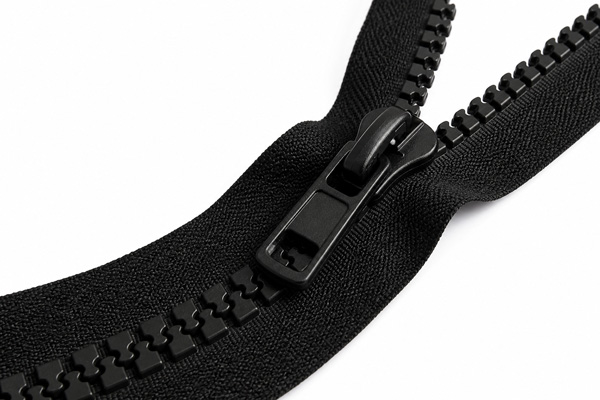
Heavy-duty zippers are fastening systems designed for applications involving higher loads, frequent opening and closing, abrasive contact, or exposure to demanding environments. Compared with zippers intended for light everyday use, they typically combine a larger chain, stronger tape, more robust sliders, and reinforced stops.
The term “heavy-duty” should not be judged by tooth size alone. A large zipper can still fail if its tape is too weak for the base material, its slider is unsuitable for repeated cycling, or its components cannot resist the surrounding environment. For industrial buyers, a heavy-duty zipper is best understood as a complete closure system in which the chain, tape, slider, puller, stops, finish, and installation method work together.
Heavy-Duty Zippers vs. Standard Zippers
The practical difference is the level and type of stress the zipper is expected to withstand.
| Selection factor | Standard zipper | Heavy-duty zipper |
|---|---|---|
| Typical load | Light or moderate | Repeated, concentrated, or structural load |
| Common chain size | Smaller gauges | Often #8, #10, or larger, depending on the application |
| Tape construction | General-purpose tape | Reinforced or high-tenacity tape selected for the base material |
| Slider and stops | Designed for ordinary use | Selected for repeated cycling, side load, gloves, or harsh exposure |
| Operating environment | Controlled or mild | Outdoor, marine, industrial, high-abrasion, high-heat, or chemical environments |
| Primary buying priority | Appearance and basic function | Strength, reliability, service life, and environmental compatibility |
Zipper gauge generally refers to the approximate width of the closed chain in millimeters. A #10 zipper, for example, has a closed chain width of approximately 10 mm, although actual dimensions and performance values vary by manufacturer and construction. Larger gauges provide more interlocking area, but they also add stiffness and may require greater operating force. Oversizing therefore does not automatically produce a better result.
Key Components: Teeth, Tape, Slider, and Stops
The performance of a heavy-duty zipper depends on more than its visible teeth.
- Teeth or coil: Create the interlocking chain and determine much of the zipper’s strength, flexibility, and resistance to separation.
- Tape: Anchors the chain to the finished product and transfers load into the surrounding fabric, film, or barrier material.
- Slider: Opens and closes the chain. Its material, geometry, locking function, and pull design affect operating force and cycle life.
- Top and bottom stops: Prevent the slider from leaving the chain and help protect the zipper ends from operational damage.
- Puller: Influences ergonomics, especially when operators wear gloves or use the zipper in wet, dirty, or low-visibility conditions.
A strong chain paired with weak tape simply moves the failure point from the teeth to the seam. In the same way, corrosion-resistant teeth do not create a marine-ready zipper if the slider or stops corrode first. Buyers should evaluate component compatibility rather than approve each component in isolation.
Why Heavy-Duty Zippers Matter in Industrial Applications
Industrial closures are often exposed to several stresses at the same time. A marine enclosure may face salt, ultraviolet radiation, moisture, wind load, and frequent movement. A machinery cover may encounter dust, oil, abrasion, and repeated access. Protective equipment may need to function while the operator is wearing gloves and may also be subject to heat, flame, chemical, or electrical requirements.
Before calling a zipper “heavy-duty,” define four conditions:
- Load: What pulling, side-loading, or internal pressure will act on the closed zipper?
- Duty cycle: How often will it be opened and closed during its expected service life?
- Environment: Will it encounter water, salt, UV exposure, dirt, heat, oil, or chemicals?
- Failure consequence: Would a zipper failure cause inconvenience, product damage, operational downtime, or a safety risk?
These four questions provide a clearer starting point than choosing the largest available zipper. They also give suppliers the information needed to recommend an appropriate material, gauge, tape, slider, finish, and opening configuration.
Planning a project? Need help deciding whether your application actually requires a heavy-duty zipper? Share your load, duty-cycle, and operating-environment requirements with our team. Request a zipper recommendation.
2. Heavy-Duty Zipper Materials and Types
Material selection determines how a heavy-duty zipper responds to load, movement, weather, and contamination. The strongest option in a laboratory is not always the most reliable option in service. A rigid metal chain may provide high tensile strength but be unsuitable for a curved enclosure, while a corrosion-resistant molded zipper may outperform metal in a marine installation.
Buyers should make two separate decisions:
- Select the chain material for the operating environment.
- Select the opening configuration for the way users access the product.
Treating these as separate choices prevents a common sourcing mistake: selecting the right material in the wrong zipper configuration.
Molded Plastic and Plastic Zippers
Molded plastic zippers use individual teeth formed directly onto the tape. Industrial versions are commonly made with durable engineering plastics and are frequently selected for outdoor, marine, and equipment-cover applications.
Their main advantages include low weight, corrosion resistance, moisture resistance, and good performance under UV exposure when the plastic and tape are properly stabilized. The larger molded teeth also provide a clear, positive engagement that is useful on covers, tents, protective cases, and heavy-duty bags.
Molded zippers are less flexible than coil zippers, so they may not be the best choice for tight curves. Buyers should also confirm the operating-temperature range and chemical compatibility of the plastic rather than assuming that every plastic zipper behaves the same way.
Metal Zippers
Metal zippers use individual teeth made from materials such as brass, aluminum, or stainless steel. They are commonly selected when high tensile strength, abrasion resistance, heat performance, or a rugged construction is required.
Brass provides durability and useful corrosion resistance in many applications. Aluminum reduces weight but may require careful evaluation in abrasive or corrosive settings. Stainless steel is suitable for applications that need greater resistance to rust or chemical exposure, although it can add cost and weight.
The chain material is only one part of the specification. For high-temperature or flame-resistant applications, the tape, thread, slider, stops, coatings, and surrounding fabric must also meet the required performance level. A metal chain attached to ordinary tape does not create a complete heat-resistant closure system.
Nylon Coil Zippers
Coil zippers use a continuous nylon or polyester monofilament sewn onto the tape. Their flexibility allows them to follow curves and move with soft structures, making them useful for industrial curtains, flexible covers, tents, equipment bags, and other installations that cannot accommodate a rigid chain.
Coil designs generally operate smoothly and can tolerate minor bending or misalignment. However, the stitching that anchors the coil and the tape construction must be strong enough for the intended load. Exposure to abrasion, contamination, heat, or chemicals should be evaluated at the system level.
Open-End, Closed-End, and Two-Way Configurations
- Open-end or separating zippers allow both sides to detach completely. They are useful where a cover, panel, or modular section must be removed.
- Closed-end zippers remain connected at one end. They are commonly used for access openings, equipment cases, cushions, and fixed covers.
- Two-way zippers use two sliders to provide access from either direction. They are valuable on long openings, large enclosures, tents, and systems that require adjustable ventilation or partial access.
- Continuous chain or extra-long zippers are supplied in long lengths for industrial curtains, shelters, containment barriers, and custom assemblies. Stops and sliders are added to match the final design.
The opening style should be defined before production because bottom components, slider direction, stop placement, and assembly methods differ.
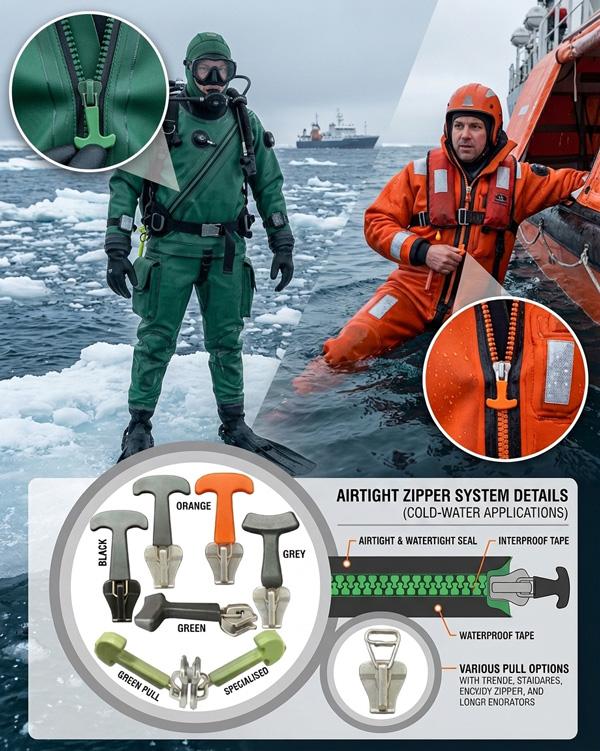
Water-Resistant, Marine, and Fire-Resistant Zippers
Special-function zippers address hazards that standard components cannot reliably handle.
- Water-resistant zippers typically use coated or laminated tape to reduce water entry through the chain.
- Marine zippers prioritize resistance to salt, moisture, corrosion, and ultraviolet exposure.
- Fire-resistant zippers combine heat- or flame-resistant components for protective equipment, industrial barriers, and other regulated applications.
“Water-resistant,” “watertight,” and “airtight” are not interchangeable terms. Buyers should request the supplier’s test method, exposure conditions, and performance limits whenever sealing is a functional requirement. The same principle applies to flame resistance: confirm the complete zipper assembly and the relevant test standard, not just the material name.
| Operating requirement | Common starting point | Items to verify |
|---|---|---|
| Marine or outdoor exposure | Molded plastic or treated coil | UV stability, saltwater resistance, slider and stop corrosion |
| Tight curves or flexible panels | Nylon or polyester coil | Coil stitching, tape strength, bend radius |
| High mechanical load | Large molded or metal chain | Gauge, lateral strength, slider strength, tape anchoring |
| Heat or flame exposure | Qualified metal or specialty plastic system | Tape, thread, coating, slider and assembly test report |
| Water control | Coated or sealed zipper construction | Water-resistance level, test pressure, seam installation |
3. Heavy-Duty Zipper Sizes and Performance Requirements
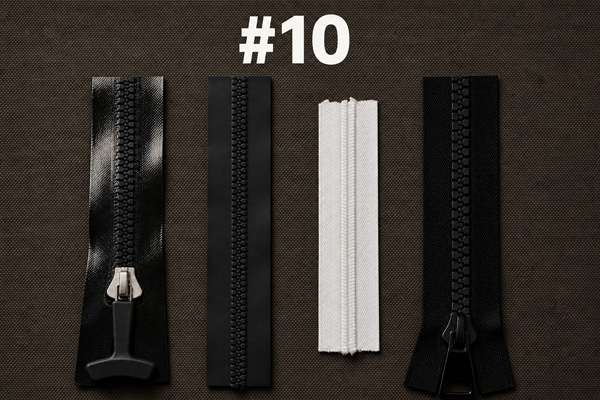
Zipper size is commonly expressed as a gauge number that approximates the width of the closed chain in millimeters. A #8 chain is approximately 8 mm wide and a #10 chain approximately 10 mm wide, although dimensions vary by manufacturer, material, and product family.
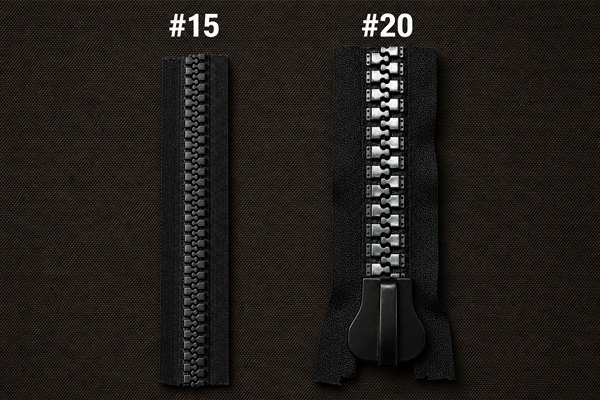
For industrial applications, #8 and #10 zippers are common starting points because their larger interlocking surfaces can handle more demanding loads than smaller chains. Some structural covers, oversized enclosures, and containment systems may require #12, #15, #20, or another specialized size. The correct gauge must be selected from test data and application requirements rather than from size alone.
How Zipper Gauge Is Measured
Gauge is measured across the closed chain, not across the full tape. The number is a convenient size reference, but it is not a guaranteed strength rating. Two #10 zippers can perform differently if they use different tooth materials, tape constructions, sliders, stops, or manufacturing tolerances.
When comparing quotations, buyers should therefore request the manufacturer’s actual chain width and relevant strength data. A nominal gauge without a product code or specification sheet is not enough for an engineering comparison.
#8, #10, and Larger Industrial Zipper Sizes
The following ranges can help begin a supplier discussion, but they should not replace application testing.

| Gauge range | General use profile | Typical industrial examples |
|---|---|---|
| #5 and smaller | Light to moderate load | Small access pockets, lightweight covers, internal compartments |
| #8 | Balanced strength and flexibility | Equipment bags, tarps, medium covers, outdoor gear |
| #10 | Heavy-duty general industrial use | Tents, marine covers, tool bags, large protective cases |
| #12 and larger | High-load or oversized systems | Modular walls, industrial curtains, containment barriers, large shelters |
Moving to a larger gauge increases chain mass and stiffness. It can also increase operating force and place more stress on the surrounding material. If the base fabric, seam design, or operator cannot accommodate the larger zipper, overspecifying can create a new failure point instead of solving the original problem.
Load, Operating Frequency, and Tensile Strength
“Strong” should be converted into measurable operating requirements. At minimum, define:
- The direction of the load: crosswise, lengthwise, peel, or side pull.
- The expected peak and normal working loads.
- The number of open-close cycles during the product’s service life.
- Whether the zipper will be operated under tension.
- Whether users may pull at an angle or operate the zipper while wearing gloves.
- The acceptable operating force.
The zipper chain, slider, stops, tape, stitching, and base material should be evaluated together. Chain strength alone does not predict the strength of the installed closure.
Abrasion, UV, Corrosion, Heat, and Chemical Resistance
Industrial zipper performance often depends more on exposure than on static strength. A buyer’s requirement sheet should identify each relevant stress and request corresponding evidence.
Avoid accepting a single “heavy-duty” label as evidence for every condition. The useful question is not “Is this zipper strong?” but “Has this zipper construction been evaluated under the loads and exposures expected in this application?”
4. Common Industrial Applications
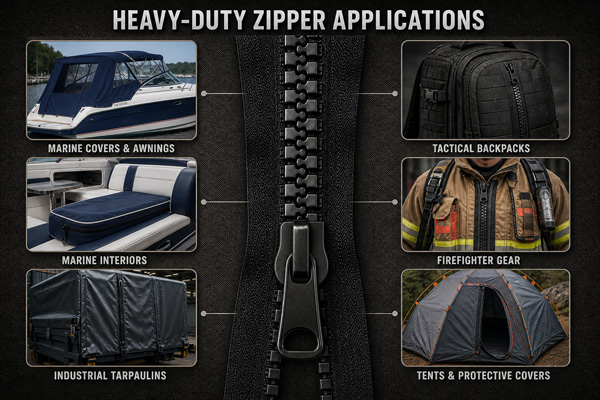
Heavy-duty zippers are used wherever a flexible product needs repeatable access without sacrificing strength or environmental protection. The application name alone does not determine the correct zipper. Buyers should identify the dominant failure risks within each use case.
Marine Covers and Enclosures
Boat covers, cockpit enclosures, bimini tops, sail bags, and marine storage compartments are exposed to moisture, salt, ultraviolet radiation, wind, and repeated movement. Molded plastic or suitably treated coil zippers are common starting points because they avoid some of the corrosion risks associated with untreated metal.
The slider, stops, puller, and stitching require the same scrutiny as the chain. A corrosion-resistant chain paired with a vulnerable slider will not provide reliable marine performance. Fresh-water rinsing and periodic inspection should also be included in the maintenance plan.
Industrial Tarps, Curtains, and Machinery Covers
Industrial curtains and machinery covers may experience dust, oil, abrasion, side loading, and frequent access. Flexible coil zippers can follow curved or folding panels, while molded or metal chains may be appropriate where higher separation resistance is needed.
The zipper tape and seam construction should be compatible with the cover material. Reinforcing the chain without reinforcing the attachment area can cause tearing beside the zipper.
Tents, Containment Barriers, and Modular Structures
Large shelters, tent doors, temporary partitions, and containment systems often require long zipper chains, two-way access, or detachable panels. These systems must balance strength with manageable operating force, especially when long openings are under fabric tension.
For containment or environmental-control applications, specify whether the closure only provides access or must also restrict dust, water, air, or other contaminants. A standard heavy-duty zipper does not automatically create a sealed barrier.
Tactical Gear and Protective Equipment
Tactical packs, emergency equipment, firefighter gear, and industrial protective equipment can subject zippers to abrasion, high cycle counts, heavy loads, gloves, heat, flame, or chemical exposure. Locking sliders and enlarged pullers can improve control and help prevent accidental opening.
Where safety or regulatory compliance is involved, buyers should verify the tested zipper assembly and its compatibility with the finished product. Component claims should not be treated as certification of the complete item.
Tool Bags, Equipment Pouches, and Protective Cases
Tool bags and technical cases combine concentrated loads with frequent access. The zipper may also follow corners, making flexibility and smooth slider travel important. Molded zippers provide robust tooth engagement, while coil zippers are useful for curved openings. Metal zippers may be selected where maximum mechanical strength or abrasion resistance is required.
| Application | Dominant stresses | Common specification priorities |
|---|---|---|
| Marine enclosure | Salt, UV, moisture, movement | Corrosion resistance, UV-stable tape, maintainable slider |
| Machinery cover | Dust, oil, abrasion, repeated access | Chemical compatibility, reinforced tape, cycle life |
| Industrial curtain | Long opening, folding, side load | Flexible chain, continuous length, two-way access |
| Shelter or barrier | Tension, weather, large opening | Gauge, reinforced seam, water or air-control requirement |
| Protective equipment | Heat, chemicals, gloves, safety risk | Qualified materials, locking slider, ergonomic puller |
| Tool bag or case | Concentrated load, corners, frequent cycling | #8/#10 starting point, tape strength, smooth curved operation |
This application-to-stress mapping gives buyers a more useful specification than copying the zipper used in a visually similar product.
Planning a project? Developing a marine cover, industrial curtain, protective case, or containment system? Send us the application details so the zipper can be matched to the real load and exposure conditions. Discuss your application.
5. How to Choose the Right Heavy-Duty Zipper
The best heavy-duty zipper is not the largest or most expensive option. It is the closure system that meets the required load, environment, access pattern, safety level, and production constraints without creating unnecessary stiffness, weight, or cost.
Use the following process before requesting quotations.
Step 1: Define the Application Environment
List every relevant exposure: indoor or outdoor use, UV radiation, saltwater, fresh water, dust, mud, oil, chemicals, high or low temperatures, and cleaning agents. Include storage conditions as well as operating conditions.
Step 2: Determine Load and Duty Cycle
Estimate the direction and magnitude of the load, how often the zipper will be operated, and whether it will be opened while the surrounding material is under tension. A zipper opened twice per year has different requirements from one opened hundreds of times per shift.
Step 3: Select the Chain Material and Gauge
Choose molded plastic, metal, or coil construction based on the environment and required flexibility. Then select a gauge capable of handling the load without making the finished product unnecessarily rigid. Request actual performance data for the proposed item code.
Step 4: Choose the Opening Style, Slider, and Puller
Specify open-end, closed-end, two-way, or continuous-chain construction. Decide whether the slider should lock, whether access is required from both sides, and whether the puller must be operated with gloves.
Step 5: Match the Tape to the Base Material
Confirm tape material, width, strength, coating, and sewing or welding compatibility. The tape and attachment seam must distribute the load into the surrounding panel without tearing or distortion.
Step 6: Confirm Special Performance Requirements
State whether the zipper must resist water, salt spray, flame, heat, oil, chemicals, static electricity, or other hazards. Ask which part of the assembly was tested, under what conditions, and to which standard. Do not rely on broad descriptions such as “marine-grade” or “fire-resistant” without supporting details.
Step 7: Validate the Installed Assembly
Test production-intent samples in the actual fabric, seam, orientation, and operating environment. A component that performs well by itself can behave differently after sewing, bending, coating, or sustained loading.
Information to Include in a Zipper RFQ
Provide suppliers with a structured brief:
- Final product and application
- Zipper location and installed orientation
- Chain material and preferred gauge, if known
- Open-end, closed-end, two-way, or continuous-chain configuration
- Finished length and acceptable tolerance
- Tape material, width, and color
- Slider material, locking function, puller style, and access direction
- Expected load and opening frequency
- Environmental exposures
- Required tests, certifications, or compliance documents
- Annual volume, order quantity, sample requirement, and delivery schedule
A complete RFQ makes competing quotations easier to compare and reduces the risk that two suppliers quote products that share a size but not the same performance.
Planning a project? Already preparing an RFQ? Share your required size, length, opening style, environment, quantity, and test requirements. Contact us for a project-specific quotation.
6. Maintenance and Common Failure Points
Heavy-duty construction extends service life, but it does not eliminate maintenance. Dirt, sand, salt, dried chemicals, poor alignment, and excessive side load can damage even a well-specified zipper.
Cleaning and Lubrication
Remove loose debris with a soft brush or damp cloth. For marine applications, rinse the zipper with fresh water after salt exposure and allow it to dry. Avoid forcing a contaminated slider because trapped particles can damage the teeth, coil, or slider channel.
Where the manufacturer permits lubrication, use a compatible silicone-based or purpose-made zipper lubricant in a small amount. Oil-based products may attract dirt and should not be used unless specifically approved for the zipper and operating environment.
Routine Inspection
Inspection should cover the complete installed system:
- Bent, cracked, missing, or misaligned teeth
- Worn coil stitching
- A loose, corroded, or deformed slider
- Missing or damaged top and bottom stops
- Frayed, cut, or stretched tape
- Loose stitching or damage in the surrounding material
- Increased operating force or repeated sticking
An increase in operating force is an early warning. Investigate contamination, misalignment, tension, or slider wear before the zipper separates or the tape tears.
Common Failure Symptoms
| Symptom | Possible cause | Initial action |
|---|---|---|
| Slider moves but chain reopens | Worn or deformed slider; damaged teeth | Clean and inspect; replace the matched slider if the chain is intact |
| Slider is difficult to move | Debris, corrosion, misalignment, excessive tension | Remove load, clean, realign, and apply approved lubricant |
| Teeth or coil separate under load | Underspecified gauge, worn slider, damaged chain, side loading | Stop use and review both damage and original specification |
| Tape tears beside the chain | Weak tape, poor seam design, concentrated load | Replace the assembly and reinforce the attachment design |
| Slider or stops corrode | Incompatible material or inadequate maintenance | Replace affected parts and review environmental compatibility |
| Water enters through the closure | Wrong zipper class, damaged coating, unsealed seam | Verify whether the design is water-resistant or sealed; inspect installation |
When to Repair and When to Replace
A worn slider or missing stop can often be replaced if the chain, tape, and attachment remain intact. Repairs must use components that match the chain material, size, and profile.
Replace the zipper when teeth are missing or broken, the coil anchoring is damaged, the tape is torn, heat or chemicals have deformed the chain, or corrosion has compromised multiple components. Individual teeth on many heavy-duty chains cannot be replaced reliably.
For critical applications, remove the product from service until the closure has been evaluated. A repair that restores movement does not automatically restore the original load rating or environmental protection.
A Practical Maintenance Schedule
- Before use: Check alignment, stops, slider movement, and visible damage.
- After dirty, wet, or saltwater exposure: Clean, rinse where appropriate, dry, and inspect.
- At planned service intervals: Check tape, stitching, slider wear, corrosion, and operating force.
- Before long-term storage: Clean and dry the zipper, relieve tension, and avoid a sharp fold across the chain.
Maintenance frequency should reflect exposure and failure consequence rather than follow one universal calendar.
7. Heavy-Duty Zipper Supplier Checklist
Selecting a supplier is part of selecting the zipper. Industrial buyers need consistent specifications, traceable quality, application support, and reliable delivery—not just a sample that opens and closes smoothly.
Materials, Sizes, and Configurations
Confirm that the supplier can provide the required chain material, gauge, tape, slider, puller, stops, coating, color, length, and opening configuration. Ask whether critical components are standard or custom and whether substitutions may occur between production batches.
Test Reports and Quality Control
Request test results that correspond to the risks identified in the application. Depending on the project, these may include chain strength, slider strength, stop strength, fatigue cycling, abrasion, corrosion, UV exposure, heat, flame, water resistance, or chemical compatibility.
Check that reports identify the tested item, size, material, test method, date, and result. A general certificate for a product family may not represent the exact zipper construction being quoted.
Ask how the supplier controls:
- Incoming materials
- Chain dimensions and tooth alignment
- Tape color and coating consistency
- Slider and stop compatibility
- Lot identification and batch traceability
- Final inspection and nonconforming product
- Engineering or production changes after approval
Customization and Engineering Support
Industrial applications frequently require nonstandard lengths, continuous chain, special sliders, enlarged pullers, resistant coatings, custom tape, or branded components. Determine whether the supplier can review the installed design rather than only manufacture from a generic item number.
Useful engineering support includes material recommendations, tolerance confirmation, prototype development, application testing, failure analysis, and written approval of the final specification.
Samples, MOQ, and Lead Time
Before approving production, request samples made as closely as possible to the final construction. Install them in the intended base material and test actual operating conditions.
Commercial terms should be evaluated alongside performance:
- Sample cost and sample lead time
- Minimum order quantity by size, color, and configuration
- Production lead time
- Capacity for repeat orders
- Color or tooling charges
- Packaging and labeling
- Change-control procedure
- Replacement or corrective-action process
Supplier Evaluation Scorecard
| Evaluation area | Questions to ask | Evidence |
|---|---|---|
| Application fit | Does the proposed zipper match the load and environment? | Written recommendation and item specification |
| Performance | Has the exact construction been tested? | Test report with identifiable product details |
| Compatibility | Do chain, slider, stops, tape, and seam method work together? | Assembly drawing or approved sample |
| Quality control | Can production lots be traced and changes controlled? | QC plan, lot code, inspection records |
| Custom capability | Can required lengths, pullers, coatings, and colors be produced? | Prototype or production-intent sample |
| Supply reliability | Are MOQ, capacity, and lead time suitable? | Quotation and delivery commitment |
| Technical support | Will the supplier help investigate failures or specification changes? | Named technical contact and corrective-action process |
Final Buying Recommendation
Do not approve a heavy-duty zipper from a product name, gauge number, or appearance alone. Define the application, identify the failure risks, specify the complete zipper assembly, review relevant test evidence, and validate the installed sample.
When these steps are followed, the zipper becomes an engineered part of the product rather than an afterthought. That approach improves reliability, simplifies supplier comparison, and reduces the risk of costly failures after production.
Planning a project? Ready to evaluate a heavy-duty zipper for your industrial product? Send your technical requirements, drawings, or target application to start a specification review. Contact our zipper team.