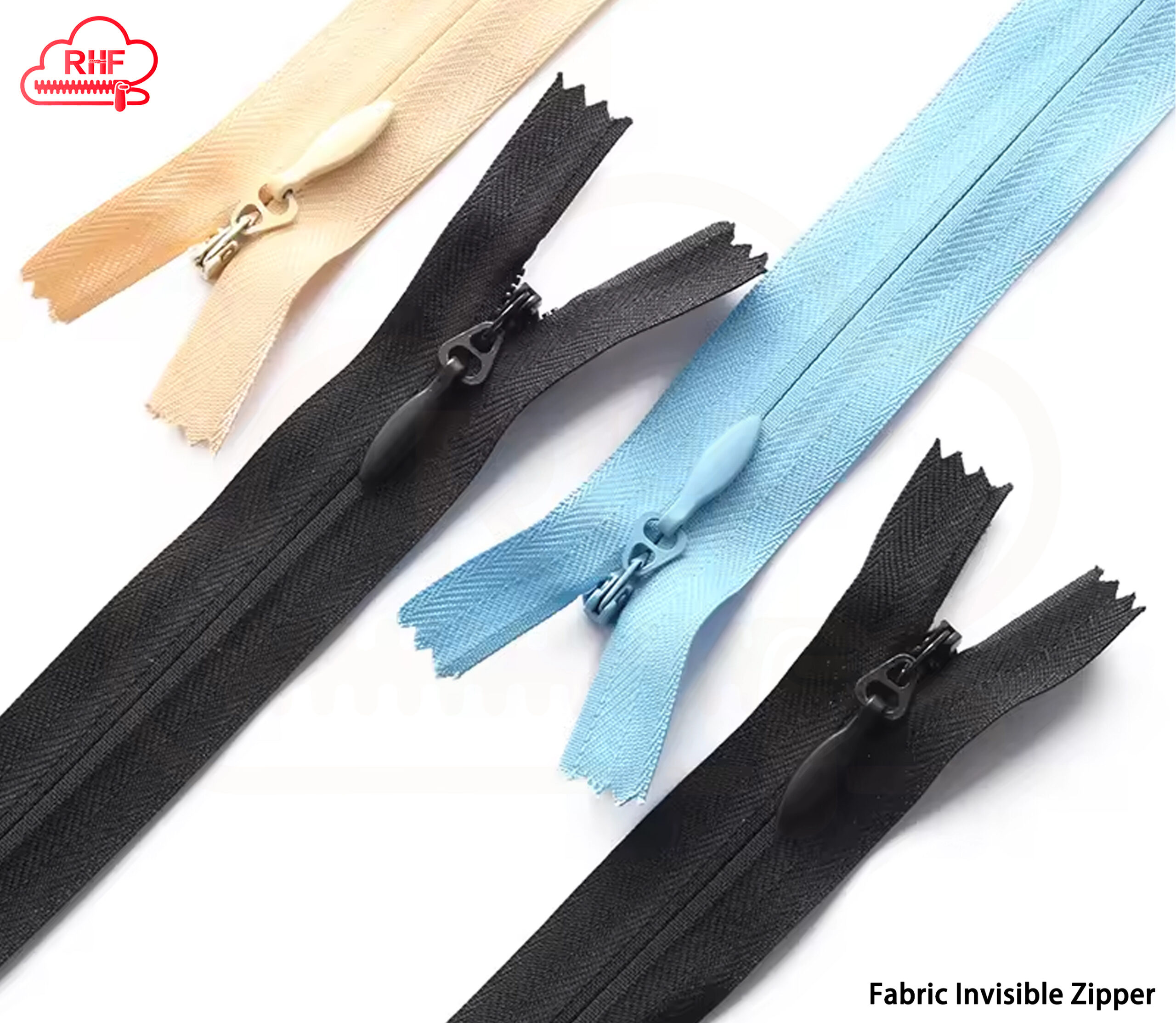
I still remember the day a premium dress brand from Italy contacted me. They ordered 50,000 invisible zippers. Three months later, they came back furious. The zippers split open during fashion shows. Their loss? Over $200,000. The problem? They thought customizing invisible zippers was simple. They were wrong.
Customizing invisible zippers requires precise control over tape material, slider tension, stopper type, and dyeing process. The real challenge is not achieving smooth operation, but balancing smoothness with burst resistance. Professional manufacturers use specific slider cavity dimensions and U-stop technology to ensure 1000+ open-close cycles without failure.
After 18 years in zipper manufacturing, I have seen too many brands make the same mistakes. This article will show you exactly how to avoid them.
A Complete Step-by-Step Guide to Custom Invisible Zipper Manufacturing?
Many buyers think invisible zipper customization is just about picking colors. That is not true. The process involves multiple technical stages.
The custom invisible zipper manufacturing process includes: requirement analysis → material selection → tape dyeing → slider assembly → stopper installation → quality testing → bulk production. Each stage requires specific technical standards to ensure final product performance meets actual wearing scenarios.
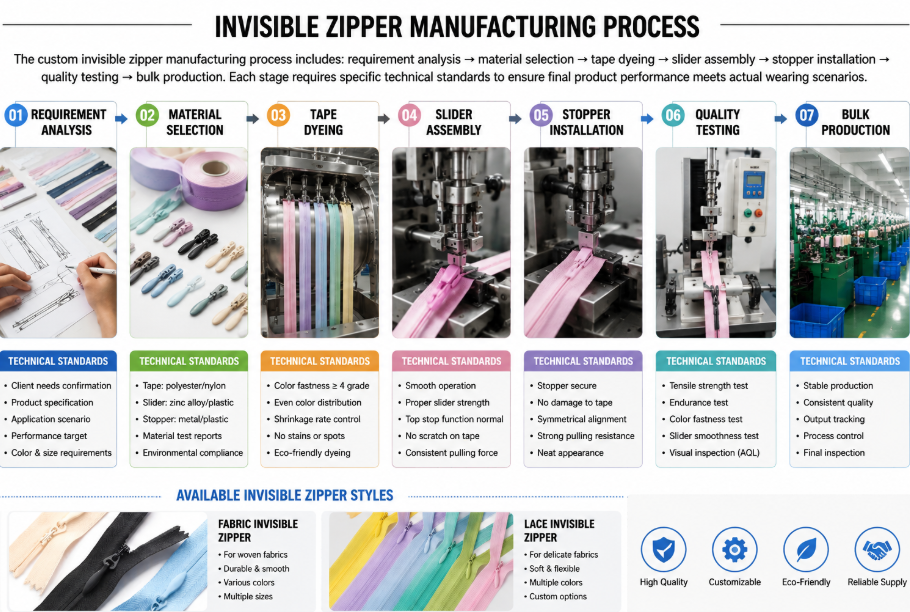
Let me walk you through each step based on our factory’s actual production workflow.
Step 1: Technical Requirement Analysis
Before production starts, we sit down with clients. We need to understand three critical factors: garment type, usage frequency, and washing requirements. A wedding dress needs different specifications than a daily-wear dress. We ask questions like: Will this garment be washed weekly? Does it need to withstand high tension? What is your target market’s quality standard?
Step 2: Material Selection and Specification Matching
This is where most buyers make mistakes. They choose materials based on appearance alone, while we guide them to select the right specifications based on actual performance requirements.
For invisible zippers, we primarily use high-quality polyester tape. Our standard tape width is 25mm, which meets the requirements of most garment applications. We also support customized tape widths for projects with specific design or manufacturing needs.
The coil size is another critical factor, as it directly affects zipper strength and durability. We help customers choose between #3 (3mm coil) and #5 (5mm coil) based on the intended application, balancing appearance, strength, and functionality.
| Coil Size | Best For | Burst Resistance | Typical Application |
|---|---|---|---|
| #3 | Light fabrics (≤150g/m²) | Moderate | Blouses, light dresses |
| #5 | Medium-heavy fabrics (>150g/m²) | High | Evening gowns, coats |
Step 3: Precise Color Matching and Dyeing
We never rely on color cards alone. I insist clients send actual fabric samples. Our technicians match colors under D65 standard light and natural daylight. We use eco-friendly dyes and maintain at least Grade 4 color fastness. This ensures no color bleeding or fading after 20+ washes.
Step 4: Slider Assembly with Tension Control
Here is the technical truth most buyers do not know: smoother is not better. We deliberately adjust slider cavity dimensions. A slightly tighter fit creates stronger bite force. This prevents zipper bursting during wear. Our standard is 1000+ open-close cycles without deformation.
Step 5: Stopper Installation Technology
We strongly recommend ultrasonic U-stop over traditional I-stop. Why? I-stop only grips the coil teeth. U-stop clamps both sides of the tape. This creates 40% stronger holding power. It prevents slider derailment, a common failure point in mass production.
Step 6: Multi-Stage Quality Testing
Every production batch undergoes three inspections: incoming material check, in-process monitoring, and final 100% inspection. We test pulling strength, smoothness, and paint adhesion. Only batches passing all tests proceed to packaging.
Key Customization Options: Tape, Slider, Length & Color for Invisible Zippers?
Customization is not about unlimited choices. It is about making the right choices for your specific needs.
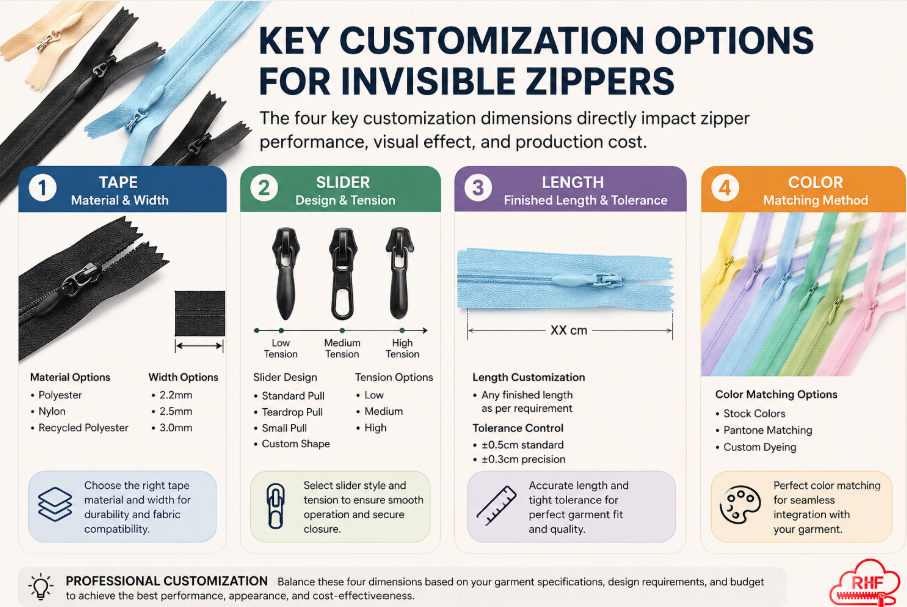
The four key customization dimensions for invisible zippers are: tape material and width, slider design and tension, finished length tolerance, and color matching method. Each dimension directly impacts zipper performance, visual effect, and production cost. Professional customization requires balancing these factors based on garment specifications.
Let me break down each customization option with practical insights from our 18 years of manufacturing experience.
Tape Customization: Material and Width Selection
Tape is the foundation of zipper performance. For invisible zippers, we primarily use polyester filament tape. Some clients request transparent edge tape for ultra-concealment. It is important to note that while transparent tape offers a cleaner visual appearance, it generally provides lower tensile strength compared to standard polyester tape. For garments with high stress points (such as tight-fitting dresses), we recommend using standard polyester tape with reinforced edges.
Tape width affects both appearance and functionality. Our standard tape width is 25mm, which is widely used across most garment applications. We also support customized widths such as 20mm and 22mm for specific design or functional requirements. Narrower tape improves invisibility, while wider tape provides stronger seam support. We guide clients in selecting the most suitable width based on garment seam allowance, fabric weight, and end-use application.
Slider Customization: The Balance Between Smoothness and Security
This is where physics meets reality. Clients often say “I want the smoothest zipper possible.” I explain the trade-off clearly. Smoother operation requires larger slider cavity. Larger cavity means weaker bite force. Weaker bite force leads to zipper bursting.
We customize slider tension based on usage scenarios. For high-frequency use garments (daily wear dresses), we set moderate tension. The zipper feels slightly firm but provides reliable security. For low-frequency garments (wedding dresses), we can reduce tension slightly for easier operation.
We also offer custom logo on slider pulls. Minimum order for custom logo is typically 3000 pieces. We can do laser engraving, embossing, or enamel filling.
Length Customization: Precision Cutting Standards
Standard invisible zipper lengths range from 10cm to 80cm. We cut to exact specifications with ±2mm tolerance. For bulk orders, we recommend ordering in standard increments (15cm, 20cm, 25cm, etc.) to optimize production efficiency and reduce costs.
For special lengths, we charge a small cutting fee. The fee covers additional machine setup time. But if your order quantity exceeds 10,000 pieces per length, we waive this fee.
Color Customization: Real Fabric Matching Protocol
We follow a strict color matching process. First, clients send actual fabric samples. Our color lab creates custom dye formulas under controlled lighting. We produce sample zippers and send them back for approval. Only after written confirmation do we proceed to bulk dyeing.
We maintain Grade 4 or higher color fastness standards. This means after 20 washing cycles at 40°C, color change remains minimal. We use AATCC test methods to verify this.
For urgent orders without fabric samples, we can match to Pantone codes. However, I always explain the risk. Pantone represents ink color, not textile color. Results may vary by ±5% in color accuracy.
MOQ, Lead Time & Cost Tips for Custom Invisible Zippers for Apparel Brands?
Every buyer asks the same question: “What is your best price?” I always answer with another question: “What is your quality requirement?”
Minimum Order Quantity for custom invisible zippers typically starts at 3000 pieces per specification (color + length combination). Lead time ranges from 15 to 35 days depending on customization complexity. Cost optimization requires balancing order quantity, specification variety, and quality standards rather than simply seeking the lowest unit price.
Let me share practical strategies to optimize your customization project based on real client cases.
Understanding MOQ Structure
Our standard MOQ is 3000 pieces per SKU. One SKU means one specific combination of color, length, and stopper type. For example, if you need black 20cm closed-end and black 25cm closed-end, that counts as two SKUs. Total MOQ would be 6000 pieces.
Many clients ask for lower MOQ. We can accommodate 1000 pieces per SKU for standard colors (black, white, beige, navy). But unit cost increases by approximately 15-20%. Why? Smaller batches require the same machine setup time. Fixed costs get distributed across fewer pieces.
For first-time clients testing quality, we offer 500-piece sample batches. This allows quality verification before committing to bulk orders. Sample batch lead time is typically 7-10 days.
| Order Quantity | Setup Time | Production Priority |
|---|---|---|
| 500-1000 pieces | Same | Lower |
| 1000-3000 pieces | Same | Standard |
| 3000-10000 pieces | Same | Standard |
| 10000+ pieces | Same | Higher |
Lead Time Calculation Framework
Standard production timeline is 15-20 days from order confirmation to shipment. This assumes standard specifications with Pantone color matching. Custom fabric matching adds 5-7 days. Special paint finishes (low-temperature spray paint for Grade 4 wash resistance) add another 7-10 days.
I always tell clients: lead time is not just about production. It includes material procurement, color confirmation, sample approval, and quality inspection. Rushing any stage compromises quality.
For seasonal buyers (fashion brands with tight collection deadlines), we offer expedited service. With 30% rush fee, we can compress timeline to 10-12 days. But we only accept rush orders if production capacity allows. We never sacrifice quality for speed.
Cost Optimization Strategies
- Strategy 1: Consolidate Specifications. Instead of ordering ten different lengths in small quantities, choose three or four standard lengths in larger quantities. This reduces SKU count and lowers unit cost.
- Strategy 2: Plan Ahead for Peak Seasons. Zipper factories experience high demand during August-October (preparing for spring collections) and February-April (preparing for fall collections). Placing orders outside peak seasons can save 10-15% due to flexible scheduling.
- Strategy 3: Quality-Based Pricing Understanding. Low-temperature spray paint costs 40% more than standard hanging spray paint. But for garments requiring frequent washing, this investment prevents massive returns. I have seen clients spend $0.05 less per zipper, then lose $50,000 in returned garments.
- Strategy 4: Long-Term Partnership Benefits. First-time buyers pay standard rates. Repeat clients with annual volume exceeding $100,000 receive tiered discounts up to 12%. We value stable partnerships over one-time transactions.
Payment Terms and Order Security
For first orders, we require 30% deposit upon order confirmation and 70% balance before shipment. We accept T/T, L/C, and PayPal (for amounts under $5000).
For established clients with good payment history, we offer NET 30 or NET 60 terms. This helps manage cash flow for brands with seasonal sales cycles.
We maintain professional liability insurance. If product defects cause client losses due to our manufacturing errors, we cover the costs. This has happened twice in 18 years. Both times we compensated clients fully and improved our processes.
Common Custom Styles: Closed-End, Open-End & U-Stop Invisible Zippers?
Not all invisible zippers work the same way. Structure determines function.
The three main invisible zipper styles are: closed-end (fixed bottom, most common), open-end (separating bottom, premium option), and U-stop configuration (ultrasonic stopper for enhanced security). Style selection depends on garment design requirements, frequency of use, and budget considerations. Each style has specific manufacturing processes and performance characteristics.
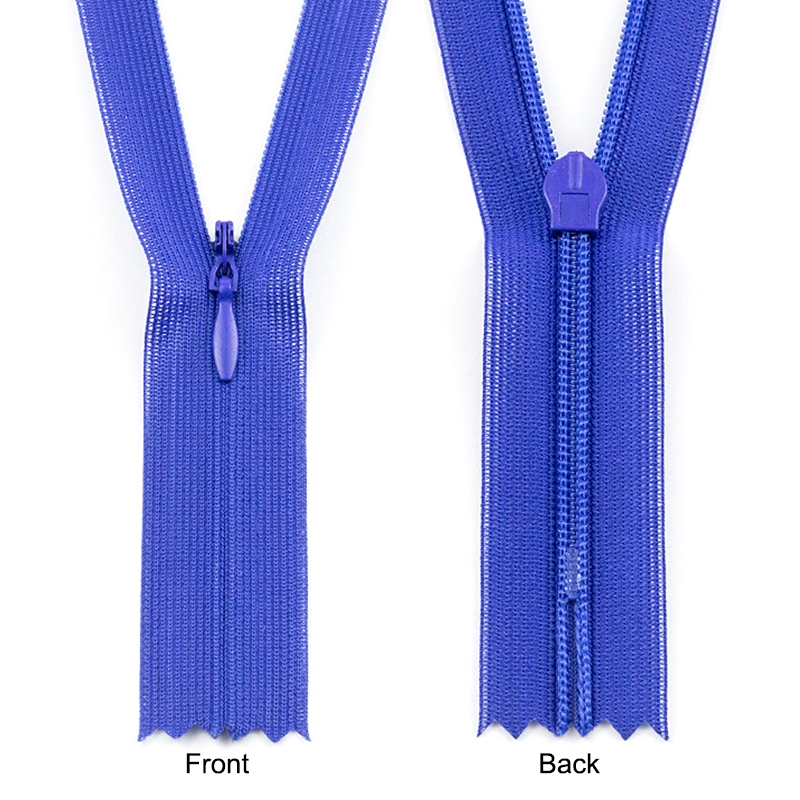
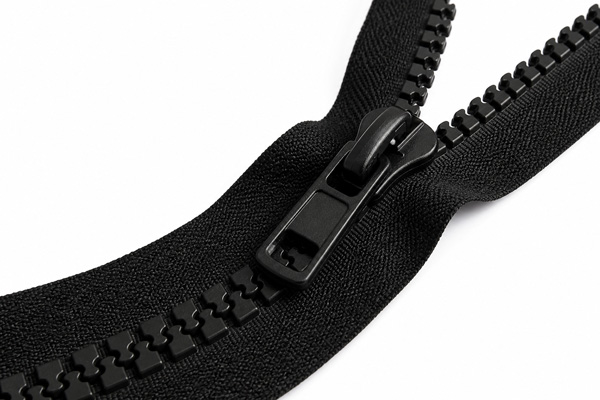
Invisible Zipper-Closed-End
(Common styles)
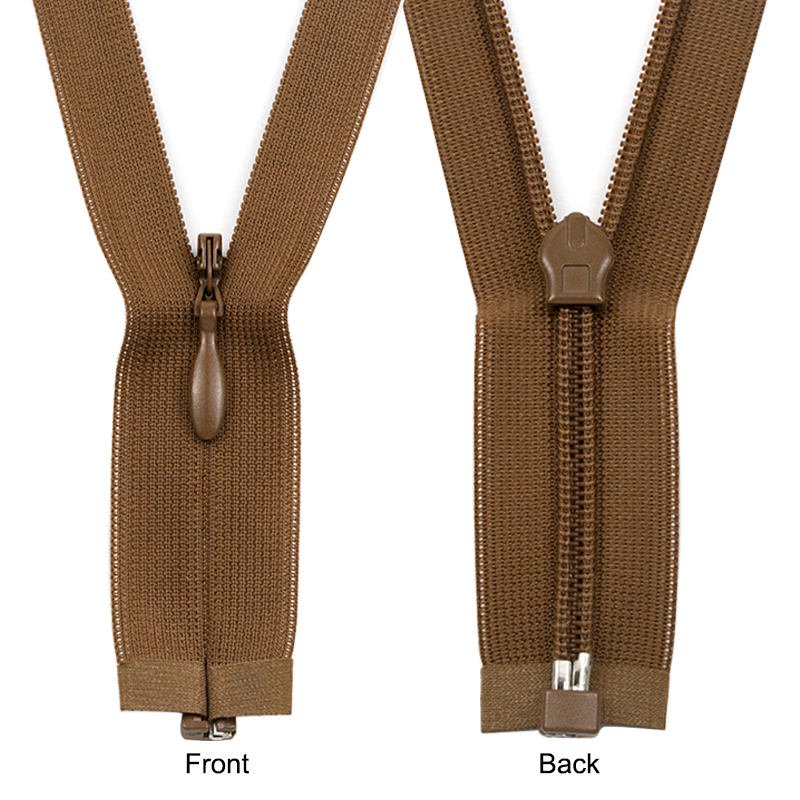
Invisible Zipper-Open End
Let me explain each style’s technical features and appropriate applications based on our manufacturing experience.
Closed-End Invisible Zippers: The Industry Standard
Closed-end invisible zippers have a fixed bottom stop. The slider cannot pass beyond the bottom. This is the most widely used style, accounting for approximately 85% of invisible zipper applications.
Manufacturing process is relatively straightforward. We attach a bottom stop (typically I-stop or U-stop) at the specified length. The top stop prevents slider from coming off the top. This creates a complete, secure closure system.
Closed-end is perfect for dresses, skirts, cushion covers, and garment backs. These applications do not require complete separation. The closed-end structure provides sufficient functionality at optimal cost.
We produce closed-end invisible zippers in any length from 10cm to 80cm. Color options are unlimited through custom dyeing. Lead time is shortest for this style because production process is standardized.
Open-End Invisible Zippers: The Premium Choice
Open-end invisible zippers feature a separating bottom. The two sides can completely detach. This allows full opening, similar to jacket zippers but with invisible aesthetic.
Manufacturing complexity is significantly higher. The bottom box and insertion pin must maintain precise tolerances. Misalignment by even 0.3mm can cause insertion difficulty. We use specialized machinery and conduct extra quality checks for open-end production.
Open-end invisible zippers are ideal for high-end applications: designer coats, convertible garments, and premium outerwear. Current market usage remains relatively low (approximately 10-15% of invisible zipper demand) due to higher cost and limited awareness.
Unit cost for open-end is typically 60-80% higher than closed-end of similar specifications. MOQ is also higher, usually 5000 pieces minimum due to specialized tooling requirements.
| Feature | Closed-End | Open-End |
|---|---|---|
| Bottom Type | Fixed stop | Separating box + pin |
| Manufacturing Complexity | Standard | High |
| Applications | Dresses, skirts, cushions | Coats, convertible garments |
| Market Share | 85% | 10-15% |
| MOQ | 3000 pieces | 5000 pieces |
U-Stop Technology: The Security Upgrade
This is where I want to focus because it directly addresses the most common failure point in invisible zippers.
Traditional I-stop wraps around the coil teeth. It provides basic stopping function. But under stress, I-stop can slip or break. We have analyzed thousands of returned defective zippers. Approximately 40% of failures involve I-stop problems.
U-stop uses ultrasonic welding technology. The stopper clamps onto both sides of the tape, not just the coil. This creates dramatically stronger holding force. In our laboratory tests, U-stop withstands 50% more pulling force before failure compared to I-stop.
The visual difference is minimal. End consumers cannot tell the difference by looking. But the performance gap is substantial. For brands serious about quality and reducing returns, U-stop is non-negotiable.
U-stop increases manufacturing cost by approximately 8-12% compared to I-stop. We recommend it for all medium to high-end garments, especially those with frequent use or high stress points. For budget-conscious projects with low-frequency use (like one-time event dresses), I-stop can be acceptable.
Combination Options for Different Scenarios
We often guide clients to use different styles within one collection. Core everyday pieces use closed-end with U-stop for maximum reliability. Outerwear pieces use open-end for functionality. Budget-friendly items use closed-end with standard I-stop to manage costs.
This mixed approach optimizes overall collection cost while maintaining appropriate quality levels for each garment type. It also prevents the common mistake of applying one-size-fits-all specifications across diverse product lines.
Conclusion
Customizing invisible zippers is not about choosing the smoothest option or the cheapest price. It is about understanding the physics of garment performance and matching specifications to actual use cases. Focus on burst resistance over smoothness, prioritize U-stop for reliability, and choose paint finishes based on washing frequency. Get these fundamentals right, and your garments will never fail at fashion shows again.